

Last Updated: April 3, 2026
The humble yet mighty wooden balance scale is a tool for understanding and discovery. It swings the scales between endless imaginative adventures.
More than a simple toy, a two-sided wooden balance scale is an invitation to explore the fundamental principles of weight, comparison, and equilibrium. It’s a hands-on learning laboratory disguised as play, appealing to children’s natural curiosity and their innate desire to experiment. Let’s weigh in on wooden weigh scales for kids.
Affiliate Link Disclosure – If you see a product you like and click through to buy it, I would genuinely appreciate it. I may earn a small commission — at no extra cost to you. It would mean a lot, thanks!
Why Every Playroom Needs a Wooden Balance Scale: Tipping the Scales Towards Development
The magic of a wooden balance scale lies in its simplicity and open-ended nature. It doesn’t tell a child what to do; it invites them to discover. From the gentle sway of the pans to the satisfying moment of equilibrium, children are actively engaged in observation, prediction, and problem-solving.
A Symphony of Skills: Beyond Basic Math
While often lauded for its introduction to early math and science concepts, the benefits of a balance scale reach far wider, nurturing a holistic range of developmental skills:
- Cognitive Development: Children naturally engage in estimation (“Which one looks heavier?”), prediction (“What will happen if I add this?”), and hypothesis testing as they experiment. They learn about cause and effect, problem-solving (how to make the pans balance), and even early critical thinking.
- Fine Motor Skills: The act of carefully placing small objects into the pans, adjusting their positions, and removing them helps refine hand-eye coordination and dexterity.
- Early Literacy & Language: Parents and children naturally use a rich vocabulary: “heavier,” “lighter,” “equal,” “more,” “less,” “balance,” “tip,” “compare,” “predict.” This enhances descriptive language and understanding of comparative terms.
- Social-Emotional Growth: When playing with others, children learn sharing, turn-taking, and cooperation. It can also foster patience and persistence as they work to achieve balance.
As acclaimed early childhood educator and author Lella Gandini once observed, “Children have ‘a hundred languages,’ but it’s important to remember that these languages are often expressed through their hands and their interactions with the physical world.” The balance scale provides a beautiful canvas for many of these “languages” to emerge.
Age-by-Age Developmental Delights
A wooden balance scale is a versatile toy that grows with your child, offering new layers of learning and engagement at different stages:
- Toddlers (18 months – 3 years): Focus is on sensory exploration, cause and effect, and simple comparisons. They delight in filling and emptying the pans, observing the movement, and noticing obvious differences in weight (e.g., a feather vs. a block).
- Preschoolers (3 – 5 years): Begin to grasp the concept of “heavier” and “lighter” more explicitly. They make predictions, experiment with balancing different objects, and start to understand “equal.” This is a fantastic time for early measurement without formal numbers.
- Early Elementary (5 – 7+ years): Ready for more structured investigations. They can use non-standard units of measurement (e.g., “how many marbles weigh as much as this apple?”), understand the idea of calibration, and engage in simple math problems related to weight.
The Art of Selection: Choosing the Perfect Wooden Balance Scale for Your Child
When selecting a wooden balance scale, you’re not just choosing a toy; you’re investing in a durable, educational tool designed to inspire for years to come. Here’s what discerning parents look for:
Understanding the Craft: What to Look for in Wooden Construction
The beauty and longevity of a wooden balance scale largely depend on its craftsmanship. Look for:
- Quality Wood: Hardwoods like beech, maple, or birch are excellent choices for their durability and smooth finish. Ensure the wood is responsibly sourced.
- Non-Toxic Finishes: All finishes should be child-safe, non-toxic, and free from harmful chemicals. A smooth, splinter-free surface is paramount.
- Sturdy Construction: The base should be wide and stable to prevent tipping, and all joints should be securely assembled.
Types of Wooden Balance Scales: Finding the Right Fit
While most wooden balance scales operate on similar principles, there are slight variations:
- Traditional Two-Pan Scales: These are the most common and classic design, featuring two suspended pans. They are ideal for direct comparison and understanding equilibrium.
- Lever Scales: Some designs incorporate a single lever arm that visually demonstrates the shift in weight, which can be a different visual aid for understanding the concept.
Safety, Durability, and Design: A Parent’s Checklist
- Certifications: Look for certifications like ASTM (American Society for Testing and Materials) or CE (Conformité Européenne), which indicate the toy meets safety standards.
- Age-Appropriate Design: For toddlers, look for larger, easy-to-handle pans and a very stable base. For older children, a scale with more precise movement and potentially smaller, more accurate pans might be suitable.
- Included Weights: Some scales come with wooden or metal weights, which are excellent for introducing standard units of measurement. If not included, consider what your child will use as “weights.”
What to Look For in a Quality Wooden Balance Scale:
- Smooth, splinter-free, non-toxic wood.
- Durable, securely attached pans.
- Stable, broad base for safety.
- Clear movement demonstrating weight difference.
- Age-appropriate size and features.
- Reputable brand with safety certifications.
Keeping Your Scale in Balance: Care and Maintenance
Wooden toys, especially those with moving parts, benefit from proper care. Wipe down your balance scale with a damp cloth and mild soap (if needed) and dry immediately. Avoid prolonged exposure to moisture or extreme temperatures, which can warp or damage the wood. Store it in a dry place when not in use.
Unleashing the Fun: Imaginative Play Ideas with Wooden Balance Scales
The real magic happens when children are given the freedom to explore. Here are some engaging activity ideas, categorized by age, to inspire play and learning with your wooden balance scale:
Toddler Explorations (18 months – 3 years): Sensory Wonders
For this age, focus on sensory engagement, cause and effect, and simple comparisons.
- “Heavy vs. Light Treasure Hunt”: Gather various objects around the house or from nature – a cotton ball, a small block, a leaf, a smooth stone. Encourage your toddler to put one in each pan and watch what happens.
Parent Prompt: “Look! This side went down. What do you think that means? Is the leaf or the stone heavier?” - “Fill & Dump Fun”: Provide scoops and small bowls of sensory materials like large pasta, dry beans, or pinecones. Let them simply enjoy the motor skill of filling the pans and watching them tip.
Parent Prompt: “Wow, you filled that pan up! What happened to the other side?”
Preschooler Discoveries (3 – 5 years): Predicting and Comparing
Preschoolers are ready to make more conscious predictions and understand concepts of equality.
- “Guess the Weight”: Before placing items on the scale, ask your child to hold two objects, one in each hand, and guess which one they think is heavier. Then test their hypothesis on the scale.
Parent Prompt: “Which one do you predict will be heavier? Let’s test it out! Were you right?” - “Equal Friends”: Challenge your child to find objects that “balance” each other. Start with identical items (e.g., two toy cars) and then move to finding different items that achieve balance (e.g., three pom-poms balancing one small block).
Parent Prompt: “Can you make the pans ‘equal’? What happens if we take one away?” - “Storytelling Scales”: Create a whimsical story where the scale is a character that helps solve a problem, like deciding which animal is heaviest, or how much fairy dust is needed to balance a feather.
- “DIY Weights Challenge”: Use common household items as non-standard units of measurement. “How many paperclips weigh as much as your eraser?” or “How many marbles equal the weight of this small apple?”
Parent Prompt: “How many of these small blocks do you think it will take to balance the orange? Let’s count as we add them!” - “Kitchen Scientist”: With supervision, use the scale to weigh small amounts of dry ingredients like pasta shapes, rice, or beans. Compare “one scoop” vs. “two scoops” or see how many tiny items balance a measuring spoon.
Parent Prompt: “If one scoop of rice makes the pan go down, what do you think two scoops will do? Will it be much heavier?” - “Mystery Weigh-Off”: Place different objects in opaque bags or socks. Have your child feel the bags without looking and predict which one is heavier, then confirm with the scale.
- Sensory bins: Use rice, beans, pasta, small blocks, or natural items.
- Play food: Weigh different fruits and vegetables.
- Building blocks: See how many blocks balance a toy animal.
- Loose parts: Buttons, pom-poms, pebbles, shells – all make excellent items to weigh.
- The Classic Montessori-Style Scale: Often crafted from smooth, natural hardwood with two simple, sturdy pans. These models prioritize functionality and aesthetic appeal, sometimes including a set of graduated wooden weights for more structured learning. They are fantastic for open-ended exploration and seamlessly blend into a beautiful playroom.
- The Playful, Themed Scale: Some brands offer scales with charming designs, perhaps a small bear or a bird as part of the structure, or colorful, non-toxic painted details. These often come with a small collection of themed wooden “weights” like fruit or small animals, encouraging imaginative play right out of the box.
- The Heirloom-Quality Scale: Look for scales meticulously handcrafted from premium solid wood, often with a visible wood grain and exceptional finishes. These are built to last generations, frequently featuring robust metal chains or ropes for the pans and a wide, stable base, signifying their superior construction.
- The Educational Set Scale: These scales are often designed with a specific learning progression in mind. They might include not only the scale itself but also a comprehensive set of wooden unit weights (e.g., 5g, 10g, 20g wooden cubes) and even activity cards to guide parents and children through various weight and measurement challenges.
- “My child just puts everything in one side, what should I do?” This is a completely normal stage of exploration! They’re learning about cause and effect. Instead of correcting, narrate what you see: “Wow, you put a lot in that pan! Look how far down it went!” Or gently suggest: “What if we try putting something in the other pan?” The goal is discovery, not immediate “correct” play.
- “What if the scale isn’t perfectly accurate?” For early childhood, perfect accuracy isn’t the primary goal. The main purpose is to understand the concept of weight comparison. If the scale is consistently off, it might indicate a flaw, but slight variations with very light objects are usually not a concern for play-based learning. Focus on the visual difference and the language it inspires.
- “How do I introduce the concept of weight without overwhelming them?” Start simple. Use everyday language (“heavy,” “light”). Don’t introduce numbers or formal units until your child is much older and shows interest. Begin with obvious differences, then move to subtler comparisons. Let them lead the play, and you can gently guide and question.
- (01) Thoth
- (02) Toppy Store
- (03) Hape
- (04) Toppy Store
- (05) Wood Wood House
Early Elementary Investigations (5 – 7+ years): Measuring and Problem-Solving
At this age, children can engage in more quantitative and problem-solving activities.
Beyond the Pans: Integrating with Other Play
A balance scale integrates beautifully with other open-ended toys. Combine it with:
Our Curated Picks: Top Wooden Balance Scales to Consider
When searching for a quality wooden balance scale, Oddblocks values craftsmanship, durability, and thoughtful design. While specific brands may vary their offerings, here are the characteristics of excellent options you can find online:
Regardless of the specific brand, look for the hallmarks of quality described in our “How to Choose” section. Reputable toy companies dedicated to wooden and eco-friendly toys often feature these kinds of thoughtful designs.
Common Questions Weighed In: Your Balance Scale FAQs
Parents often have practical questions when introducing a new educational toy. Here are a few we frequently encounter:
Bringing Balance to Playtime
A wooden balance scale is far more than a simple plaything; it’s a profound educational tool, a catalyst for imagination, and a beautiful heirloom that can be enjoyed for years. It fosters a deep, intuitive understanding of scientific principles, all while encouraging creativity and critical thinking.
By choosing a well-crafted wooden balance scale and embracing its potential for open-ended exploration, you’re not just adding a toy to your collection – you’re adding a rich learning experience that truly tips the scales towards a brighter, more curious childhood.
***
✅ A wooden balance scale teaches what “balance” truly means—long before kids ever see the word on a bank statement or math worksheet.
✅ Real working scales show how equality, fairness, and justice take shape in small, visible ways—one weight at a time.
✅ Balancing toys build focus, fine motor skills, and curiosity about how the world measures and compares things.
Affiliate Link Disclosure – If you see a product you like and click through to buy it, I would genuinely appreciate it. I may earn a small commission — at no extra cost to you. It would mean a lot, thanks!
Top Wooden Balance Scale Toys
Oddblocks Opinion: The wooden balance scale is a tactile reminder that learning begins with the hands. Each time a child lifts, adjusts, and releases the beam, they are feeling the laws of physics come alive. Parents notice something deeper too — a balanced scale becomes a quiet ritual of fairness, showing children that balance is something you can build and feel.
(01) Thoth
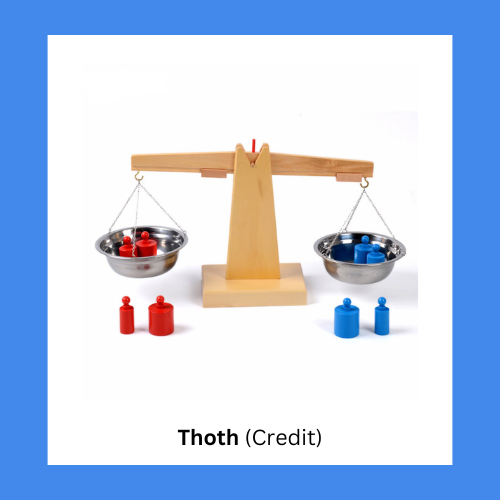
The Thoth wooden balance scale is a Montessori-style learning toy that introduces early lessons in weight and symmetry. Children place objects on each side to explore the idea of equality and experiment through hands-on play. It is suitable for home or classroom use, encouraging cognitive and fine motor development while nurturing curiosity about measurement. The toy comes with a 30-day return guarantee and is made from durable, child-safe materials. See Thoth on Amazon.
(02) Toppy Store

This handcrafted wooden balance scale by Toppy Store helps toddlers understand weight and comparison in an intuitive, playful way. Designed for natural learning, children can test real objects—like fruits or toys—to see which is heavier. With smooth, splinter-free edges and no small pieces, it’s both safe and charming. Parents also appreciate its decorative simplicity, making it an attractive addition to a nursery or preschool shelf. See Toppy Store on Etsy.
(03) Hape
Visit the Hape official website.
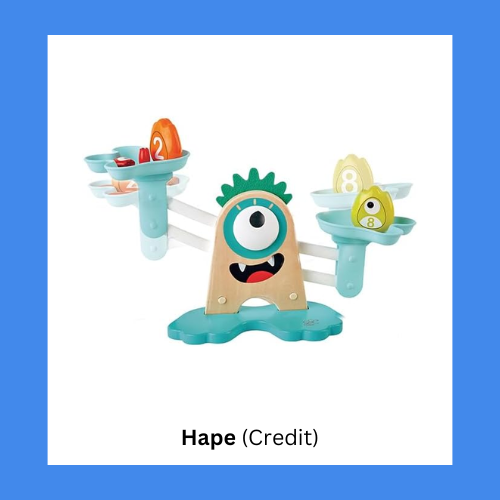
Hape’s Math Monster Scale turns the concept of weighing into a full STEM experience. The toy includes a set of colorful monster weights designed to teach balance, addition, and subtraction through visual and tactile challenges. With three difficulty levels, children learn math through play while improving focus and hand coordination. Made from durable wood and water-based paints, this set includes a cloth storage bag for easy cleanup. See Hape on Amazon.
(04) Toppy Store …again!
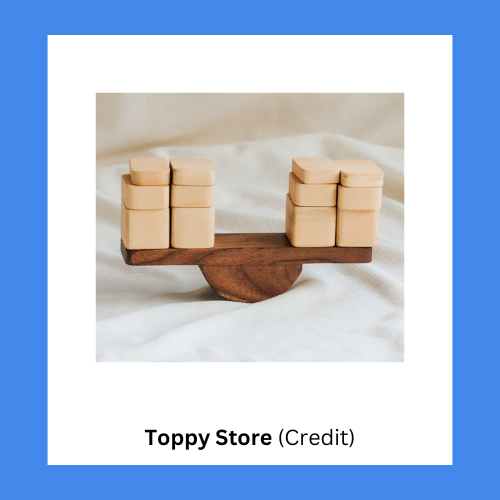
The Toppy Store wooden seesaw balance toy is a compact, beautifully finished Montessori piece crafted from natural walnut wood. It encourages toddlers to explore equilibrium by keeping both ends balanced through experimentation. The toy sharpens spatial awareness, fine motor control, and patience while remaining eco-friendly and safe. With smooth rounded edges and minimalist design, it’s equally suited as a playroom tool or thoughtful toddler gift. See Toppy Store on Etsy.
(05) Wood Wood House
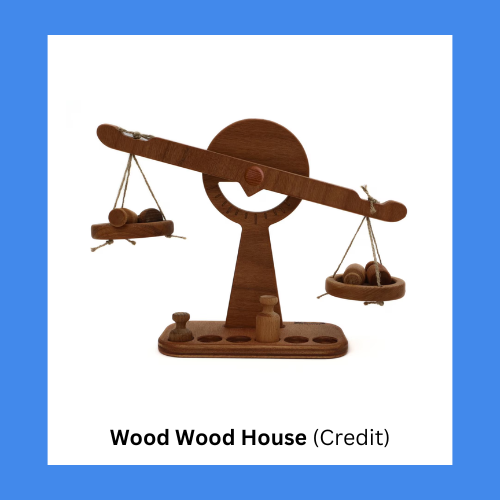
This Montessori wooden balance scale by Wood Wood House blends craftsmanship and developmental psychology. Created under the guidance of a clinical psychologist, it promotes early math understanding, sensory exploration, and emotional growth. The solid beechwood construction and non-toxic finish reflect sustainable values, while its thoughtful design nurtures hand-eye coordination and logical reasoning. It’s a versatile learning tool suitable for both home and classroom use. See Wood Wood House on Etsy.
Over to you!
A wooden balance scale invites calm, focused play that connects movement to meaning. Whether it’s counting coins, comparing fruits, or simply finding center, each use teaches fairness, patience, and discovery. Explore these scales and see how play can quietly balance learning and joy.


