

Picture this — you pull out the same old bucket of wooden blocks, expecting the usual two-minute stacking session and one dramatic crash — and instead your child ends up quietly absorbed for half an hour, inventing tiny cities, measuring the couch, and narrating a whole story about a block that “doesn’t like being on the bottom.”
That’s the version of block play we’re after here.
Today we’re sharing all about simple, realistic block activities you can set up at home with a basic set of wooden blocks — nothing fancy, nothing Pinterest-perfect, just thoughtful ideas that stretch across toddler and preschool years.

Open-ended blocks work for all kinds of activities
Beyong just “keeping them busy” — wooden blocks are one of those rare toys that quietly work on almost everything at once:
- Spatial reasoning and visual thinking. When kids line up, balance, stack, and angle blocks, they’re rehearsing the same spatial skills they’ll later need for geometry, reading charts, and even parallel parking.
- Early math, without worksheets. Blocks are basically living math manipulatives: children count towers, compare “taller/shorter,” group by shape, and experiment with symmetry and patterns — long before anyone hands them a workbook.
- Language and storytelling. It looks like “just building,” but block play is full of quiet narration: This is the animal hospital. This one is the ambulance. That self-talk and pretend-play dialogue is a huge boost for language and narrative skills.
- Problem-solving and experimentation. Every wobbly tower is a miniature physics experiment — kids test ideas, adjust for balance, and learn to predict what will tip or hold.
- Cooperation and negotiation. When more than one child is involved, block play becomes a crash course in sharing materials, negotiating plans, and sometimes coping with the tragedy of “Someone knocked my bridge over and I’m very offended about it.”
In a nutshell — a simple bin of wooden blocks is quietly doing the work of half a toy store.

Setting up a block play environment
You don’t need a classroom block corner to make these activities work. A few tweaks go a long way:
- A flat build zone — rug, low table, or taped-off area on the floor.
- A consistent set of wooden blocks — basic shapes, nothing special required.
- Optional loose parts — small toy cars, animals, wooden people, scarves, cardboard tubes, painter’s tape, a roll of kraft paper.
Every activity mentioned today is doable with ordinary wooden building blocks. If you have magnet blocks or plastic sets, they can join the party — but they’re optional, not required.

Easy wooden block activities for toddlers (1–3 years)
Toddlers do not care about elaborate invitations to play. They care about cause and effect, repetition, and the satisfaction of knocking things over with great gusto. Keep setups fast and expectations low; the learning is happening even if the activity lasts five minutes.
(01) Block bowling
Set up a “bowling alley” with blocks as pins and something that rolls — a small ball, a cylindrical block, or even a sturdy cardboard tube taped into a roll.
- Stand 5–6 blocks up in a row or triangle.
- Show your toddler how to roll the ball toward the blocks.
- Celebrate when everything collapses in a noisy heap.
✅ Skills in disguise — gross motor coordination, hand–eye coordination, early counting (“How many blocks fell?”), and cause-and-effect.
✅ Make it easier — Move the starting line closer or use fewer “pins.”
✅ Make it harder — Ask your older toddler to predict how many blocks will fall before they roll.
(02) “Tall, taller, tallest” stacking
This is classic tower-building, but with a tiny dose of math language.
- Put a small pile of blocks in front of your child.
- Build one short tower, one medium, and one taller one side by side.
- Label each tower as you build: This one is tall. This one is taller. Can we make one that’s the tallest of all?
✅ Skills in disguise — comparison words (tall, taller, tallest), early measurement ideas, and fine motor control as kids place blocks more carefully.
✅ Toddler version — You handle most of the stacking while they hand you blocks or knock towers down between attempts.
✅ Preschool extension — Use a simple chart or sticky notes to show the number of blocks in each tower.
(03) Color sorting “parking lots”
If your wooden blocks are painted, this becomes a quick color-sorting game. If not, you can tape colored paper to the floor.
- Use painter’s tape or colored paper to mark small “parking spaces” on the floor — one color per space.
- Place a basket of mixed-color blocks in the middle.
- Invite your toddler to “park each block in the matching color spot.”
✅ Skills in disguise — color recognition, sorting, visual scanning, and gross-motor movement as they toddle around the “parking lot.”
✅ Make it more playful — Add tiny wooden cars or animals that “live” in the same color space as the blocks.
(04) Fill-the-outline floor puzzle
Adapted from classroom block “floor puzzle” setups, but simplified for home.
- Lay out a big sheet of kraft paper or butcher paper.
- Trace around a handful of blocks to create different shapes on the paper — include both single-block outlines and simple 2–3 block combinations.
- Tape the paper to the floor and put a small basket of those blocks nearby.
- Show your child how to find a block that fits inside each outline.
✅ Skills in disguise — matching, shape recognition, visual–spatial awareness, and perseverance figuring out which block belongs where.
✅ Toddler version — Keep outlines simple and use very obvious shapes (rectangles, squares).
✅ Preschool extension — Create more complex outlines — long “roads,” letter shapes, or simple houses to fill with multiple blocks.
(05) Scoop, pour, and share the blocks
If your toddler loves dumping things out (so, all toddlers), lean into it.
- Place blocks in a shallow bin on the floor.
- Add a few scoops, cups, or small bowls.
- Invite your child to scoop blocks, transfer them between containers, “serve” them as pretend food, or deliver them to different “stations” around the room.
✅ Skills in disguise — hand strength, wrist rotation, bilateral coordination, simple counting (“two blocks in each bowl”), and early social play if you join as a “customer.”
✅ Extra advice — keep the number of blocks modest here. A small bin is easier to tidy than the entire block collection spread across the kitchen.
(06) Hide-and-seek with one special block
Object permanence is still big business in toddler brains.
- Choose a distinctive block (a certain color or shape) and name it — “the golden block,” “the rocket block,” etc.
- Have your toddler close their eyes (or face the other way) while you hide it somewhere in the room at toddler height.
- Offer simple clues: “It’s near something soft,” “It’s hiding by your shoes.”
- When they find it, they can hide it for you.
✅ Skills in disguise — memory, listening, language, and simple turn-taking.
✅ Make it cozier — Turn the lights low and use a flashlight to “spotlight” the hidden block.
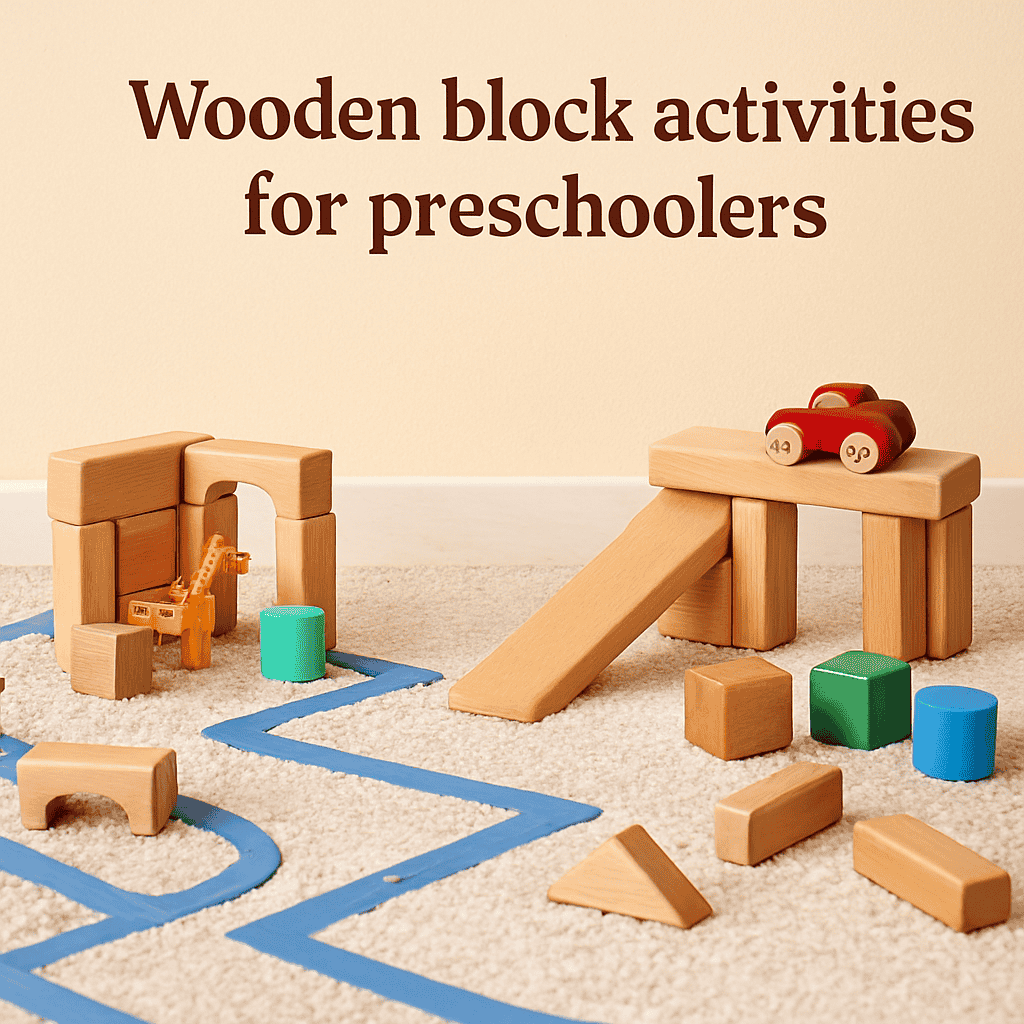
Wooden block activities for preschoolers (3–5 years)
Preschoolers are ready for more intentional building — mazes, bridges, patterns, and story worlds. You don’t have to make every session “educational” — the math and spatial work are happening whether you mention them or not — but you can gently layer in more structure.
(07) Build a block maze
Mazes are an easy upgrade from simple rows of blocks.
- Clear a rectangular build zone on the floor.
- Help your child line blocks up to create walls of a simple maze: one entrance, one exit.
- Add a small toy car, marble, or animal that needs to “find the way home.”
- Let your child test and adjust the walls as they guide their character through.
✅ Skills in disguise — planning, problem-solving, spatial reasoning, and early mapping skills (children track paths and dead ends).
✅ Make it collaborative — You lay the start of the maze; they finish it or add “tricky parts.”
(08) Bridges and ramps — how strong can we make it?
This is where physics quietly moves in.
- Place two “islands” on the floor: two low stools, stacks of books, or sturdy block towers.
- Challenge your child to build a bridge between the islands using only blocks.
- Once it holds, start testing it with different “loads”: toy animals, cars, little piles of coins.
- Try adding ramps up to the bridge with long, flat blocks or boards.
✅ Skills in disguise — engineering thinking, balance, weight distribution, persistence, and vocabulary like “sturdy,” “collapse,” “support.”
✅ Optional variation — Invite your child to predict what will happen before you add each new item to the bridge.
(09) Symmetry builds — mirror my half
This introduces symmetry in a very literal, hands-on way.
- Place a strip of painter’s tape down the middle of your build surface as a “mirror line.”
- On one side of the line, build a simple structure: a small tower, a pattern of flat blocks, or a “castle” front.
- Ask your child to copy your structure on the other side so both halves match.
✅ Skills in disguise — symmetry, left–right awareness, visual discrimination, and careful observation.
✅ Level up — Switch roles so that your child builds the first half, you copy. Let them be the “symmetry inspector.”
(10) Block stories and small-world scenes
This is where language, storytelling, and empathy sneak into a pile of blocks.
- Lay out blocks plus a few “characters” — wooden people, animals, cars, or whatever your child loves.
- Invite your child to build a setting: zoo, town, train station, animal rescue center, spaceport.
- As they build, ask open questions: Who lives here? What do they do in the morning?
✅ Skills in disguise — narrative structure, vocabulary, emotional expression, and perspective-taking as children invent different roles.
✅ Let kids lead — Even if it makes zero sense by adult standards. The point is the imaginative rehearsal, not plot quality.
(11) “Measure everything” with blocks
No rulers required — the blocks are the measuring tool.
- Choose a standard unit: one particular block shape becomes “one block long.”
- Invite your child to measure household objects: couch cushions, the coffee table, their stuffed animals, your forearm.
- Record the “measurements” on a simple list: “Couch: 15 blocks, Teddy: 6 blocks.”
✅ Skills in disguise — nonstandard measurement, one-to-one correspondence, counting, and comparison (“Which object needs more blocks?”).
✅ Expand to drawing/writing — Have your child draw a picture of an object and write the number of blocks next to it.
(12) Pattern paths and “follow the code”
Patterns are everywhere in block play; here we just make them explicit.
- On the floor, lay out a short repeating pattern with blocks: Color patterns in red–blue–red–blue… Shape patterns like square–rectangle–square–rectangle…
- Ask your child what comes next.
- Extend the pattern across the floor as a long “path.”
- Add a toy figure and let it walk only on blocks that keep the pattern going.
✅ Skills in disguise — pattern recognition, prediction, attention to detail, and early coding-like thinking (following a rule or sequence).
✅ Increase the difficulty — let your child invent their own pattern and see if you can “follow the code” correctly.
(13) Blueprint copying — build what you see
This activity connects drawing, planning, and 3D building.
- On a piece of paper, draw a simple “blueprint” of a block structure from a top-down view — for example, three squares in a row with one square on top.
- Hand your child the paper and the matching blocks.
- Challenge them to build what they see in the drawing.
- Swap roles so your child draws the blueprint and you attempt to build it.
✅ Skills in disguise — visual–spatial translation (2D to 3D), planning, and communication (“You forgot this block, it goes right here.”).
✅ Make it sillier — add customers like stuffed animals or dolls that “ordered” a particular design and come to check on the builder.
(14) Block towns with “real world” problems
Once your child is comfortable building towns, add light problem-solving.
- Build a small town together: a few houses, a road, a bridge, maybe a park.
- Introduce a scenario: The river is flooding; how can we protect the houses? The animals can’t get across the road safely.
- Invite your child to redesign the town to solve the problem: raise the bridge, build walls, make a tunnel, etc.
✅ Skills in disguise — flexible thinking, empathy (“We don’t want the animals to get hurt”), and iterative design.
✅ Keep it light — this is not an urban planning exam. Let the solutions be charmingly impractical.

Group wooden block activities for friends (siblings, cousins, playdates)
When toddlers and preschoolers share the same block basket, chaos is guaranteed. These activities give everyone a job.
(15) Collaborative “city build”
- Define a build zone on the floor with tape or a blanket.
- Give each child a specific “contract”: One child builds all the bridges, Another builds houses.
- When the city is done, take a photo and do a quick “tour.”
✅ Skills in disguise — teamwork, planning, division of labor, and language as kids explain their contributions.
✅ Toddler support — let the youngest child be in charge of demolition — they get a turn to knock it all down at the end, with warning and consent from everyone else.
(16) Tower challenges with silly rules
This works well with siblings or a small group.
Set up a series of “tower challenges,” such as:
- “Build a tower using only one hand.”
- “Build a tower that has a doorway big enough for this toy animal.”
- “Build a tower that uses exactly ten blocks.”
- “Build a tower while you’re sitting on a pillow and can’t move your feet.”
✅ Skills in disguise — counting, planning, motor control, frustration tolerance, and creativity.
✅ Keep it kind — avoid turning it into a high-pressure competition. Focus on “Let’s see what happens if…” rather than who “wins.”

Practical tips for parents leading block activities
- Rotate, don’t dump. You don’t need every block out every day. A smaller selection plus one or two of these activities is often enough.
- Name the skills out loud — gently. A quick comment like “You figured out how to make it stronger” or “You made a pattern without even trying” helps children connect their play with their own growing abilities.
- Take photos of big builds. This gives your child a sense of pride and makes it a bit easier to cope when gravity inevitably wins.
- Accept that knocking down is part of the curriculum. Destruction is not the opposite of learning here; it’s part of testing ideas and starting again.
Over to you!
If you already own a bin of wooden blocks, you don’t need to buy anything else to make block play feel fresh again. Choose a new activity from today’s wooden block play ideas, try them out, and see which ones your child quietly returns to on their own. That’s usually your best sign that the blocks — and their brain — are doing exactly what they’re meant to do. Playing. Building. Growing.


