Last Updated: April 1, 2026
A play kitchen is appropriate from around 18 months and remains a genuinely engaging toy through age 6 or 7 — sometimes longer. That’s an unusually wide play window for a single toy, which is part of what makes it worth the investment.
The right kitchen and the right accessories, however, depend significantly on where your child is developmentally. Here’s what works at each stage.
Affiliate Link Disclosure – If you see a product you like and click through to buy it, I would genuinely appreciate it. I may earn a small commission — at no extra cost to you. It would mean a lot, thanks!
Play Kitchen by Age: What to Expect
12–18 months: Too early for a full kitchen
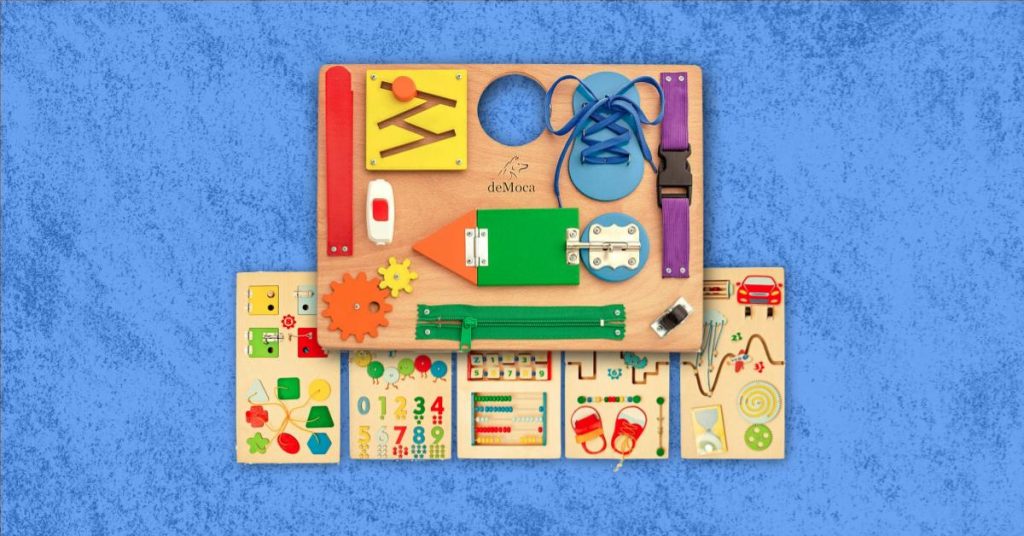
Most children under 18 months aren’t yet ready to engage meaningfully with a play kitchen. They can open and close doors and turn knobs, but the role-play element — cooking a meal, serving food, running a restaurant — requires symbolic thinking that typically emerges around 18 months. A simpler toy with tactile elements (a busy board, a shape sorter, a wooden activity cube) is developmentally better suited at this stage.
Exception: if you have a slightly older sibling already using a play kitchen, a younger child will often engage with it earlier through imitation. In that case, 12–15 months can work with supervision.
18 months – 2 years: First kitchen, simple setup
This is the earliest genuinely appropriate age for a dedicated play kitchen. Children at this stage understand cause and effect, enjoy imitating adult activities, and are starting to engage in simple pretend play. They’ll turn knobs, open doors, put things in the oven and take them out, and “stir” in a pot.
What to look for: A simple, sturdy kitchen with satisfying tactile elements — clicking knobs, swinging doors — and no small loose accessories that pose a choking hazard. Avoid complex feature-heavy kitchens at this stage; simplicity holds attention better than overload. A kitchen with a handful of large, chunky play food pieces is plenty.
Good picks at this age: Hape Gourmet Kitchen, Robud Toddler Kitchen — both are appropriately simple without being under-featured. See our full list: best wooden play kitchens.
2–3 years: Peak kitchen play begins
Ages 2–3 are when kitchen play really takes off. Children develop more elaborate pretend scenarios — cooking specific meals, serving family members, running a café — and begin combining kitchen play with other toys (stuffed animals as customers, blocks as food, etc.). This is also when cutting play food becomes appropriate and deeply satisfying.
What to look for: A kitchen with enough features to support evolving play — multiple cooking zones, storage space for accessories, a sink. Cutting play food with Velcro connections is ideal at this age. The kitchen should be large enough to still feel appropriately sized at age 4–5, since you’re now in peak use territory.
Good picks at this age: Tiny Land, Best Choice Products Farmhouse, KidKraft corner kitchen for larger spaces. For accessories, see: best wooden play food sets.
3–5 years: Most sophisticated play window
This is where play kitchen investment pays off most clearly. Children 3–5 engage in rich, extended imaginative scenarios — full restaurants with menus and customers, family dinners with assigned roles, grocery shops with a cash register. They use the kitchen as a stage set for increasingly complex social play, often with multiple children.
What to look for: A kitchen that accommodates two children comfortably — wide countertops or a corner unit. Accessories matter now more than the kitchen itself: play food variety, cookware, a cash register, a shopping cart. Consider adding a wooden cash register or wooden shopping cart to extend the play ecosystem.
5–7 years: Play evolves, kitchen remains relevant
Many children continue to use a play kitchen actively through age 6–7, particularly in multi-child households. Play becomes more narrative and collaborative — running a restaurant, hosting dinner parties, recreating specific meals they’ve helped cook in the real kitchen. At this stage the kitchen itself matters less than the accessory ecosystem around it.
What to look for: More realistic accessories — wooden tableware, a smoothie blender, a coffee maker. Children at this age appreciate props that feel like scaled-down versions of real kitchen equipment.
7+ years: Usually outgrown as primary play
Most children naturally phase out kitchen play as a primary activity around age 7, though it often continues in the background for younger siblings or occasional play. A well-made wooden kitchen holds its value for resale or hand-me-down at this stage.
Quick Reference: Age vs. Kitchen Type
| Age | Kitchen type | Key accessories | What to avoid |
|---|---|---|---|
| 12–18 months | Skip the kitchen — too early | Activity cube, busy board | Small loose pieces |
| 18m – 2 years | Simple, sturdy, minimal | Large chunky play food only | Complex features, electronics |
| 2–3 years | Mid-range with storage | Cutting play food (Velcro) | Tiny loose food pieces |
| 3–5 years | Feature-rich or corner unit | Full food sets, cookware, register | Undersized countertop for 2 players |
| 5–7 years | Same kitchen, more accessories | Realistic props, tableware, blender | Replacing kitchen — extend instead |
Is a Play Kitchen Worth the Money?
Yes — if you buy at the right time. The optimal purchase window is 18 months to 3 years, which gives you the longest possible period of active use before the child’s interests expand beyond kitchen play. Buying too early (under 18 months) means a toy that sits unused for a year. Buying too late (age 5+) means a shorter return on a significant purchase.
For the best value, aim for a kitchen that will still be appropriately sized at age 5 — which means buying slightly larger than feels necessary at 18 months. The extra counter height and storage space that feels big for a 2-year-old becomes exactly right for a 4-year-old running an elaborate restaurant operation.
See our full roundup of the best wooden play kitchens for specific product recommendations at every price point, and our guide to wooden play kitchens made in the USA if you want an American-made option.