

At Oddblocks, we believe play is the most powerful catalyst for learning. When it comes to preschool shapes, it’s not just about memorizing names; it’s about building foundational cognitive skills that will support a lifetime of learning. Shapes are everywhere – from the circular wheels on a car to the rectangular screen you’re reading this on – and introducing them through engaging, thoughtful play lays critical groundwork for math, literacy, and problem-solving.
This comprehensive guide delves into why shapes are so vital, what makes a truly great shape toy, and our curated picks for the best preschool shape toys that foster genuine developmental growth.
Affiliate Link Disclosure – If you see a product you like and click through to buy it, I would genuinely appreciate it. I may earn a small commission — at no extra cost to you. It would mean a lot, thanks!
The Foundation of Fun: Why Shapes Are Crucial for Early Childhood Development
Learning shapes is far more than a simple rote exercise. It’s an immersive experience that ignites multiple areas of a child’s brain, preparing them for more complex concepts down the line.
Cognitive Growth: Problem-Solving & Spatial Reasoning
When a toddler tries to fit a square peg into a round hole, they’re not just playing; they’re engaging in active problem-solving. They’re testing hypotheses, making observations, and adjusting their approach. This trial-and-error process is fundamental to developing critical thinking skills. Furthermore, recognizing and manipulating shapes enhances spatial reasoning – the ability to understand and remember the spatial relations among objects. This skill is crucial for everything from reading maps to understanding geometry.
Boosting Fine Motor Skills & Hand-Eye Coordination
Many shape-learning activities, such as placing pegs into boards, fitting puzzle pieces, or stacking blocks, require precise movements of small muscles in the hands and fingers. This develops fine motor skills, which are essential for tasks like writing, drawing, and self-feeding. The coordination required to line up a shape with its corresponding slot also sharpens hand-eye coordination, a vital skill for physical activities and future academic endeavors.
Beyond Basics: Introducing Advanced Shapes & Concepts
While circles, squares, and triangles are the starting point, the world of shapes extends far beyond. As children master basic forms, they can gradually be introduced to more complex shapes like ovals, rectangles, diamonds (rhombuses), and even three-dimensional shapes such as cubes, cylinders, and spheres. This progression helps them understand abstract concepts, categorisation, and lays early groundwork for geometric principles.
Creative Ways Kids Learn Shapes
Children absorb information most effectively when they are actively engaged and having fun. Here are some playful ways preschoolers learn shapes:
- Sensory Play: Using playdough to create shapes, drawing shapes in sand, or finding shape cut-outs in a sensory bin.
- Real-World Exploration: Pointing out shapes in their environment – the rectangular door, the circular clock, the triangular roof.
- Games & Activities: Playing “I Spy” with shapes, sorting shapes by colour or size, or creating patterns with different shapes.
The Enduring Appeal of Quality Shape Toys: Our Philosophy
At Oddblocks, we advocate for toys that are not only engaging but also built to last, safe for little hands, and kind to our planet. This is particularly true for shape toys, which see a lot of hands-on action.
Unmatched Durability & Longevity for Generations
High-quality shape toys, often crafted from robust materials like wood, are designed to withstand years of enthusiastic play. They don’t just last through one child’s early years; they can become cherished heirlooms, passed down through siblings or even generations. This longevity speaks to a commitment to quality and thoughtful design.
The Eco-Friendly Choice: Sustainable Sourcing & Materials
In an age of conscious consumption, the materials used in children’s toys matter more than ever. Many of our favourite shape toys are made from sustainably sourced wood, often bearing certifications like FSC (Forest Stewardship Council), ensuring responsible forest management. Paired with non-toxic, water-based paints and finishes, these toys offer peace of mind, knowing they are safe for children and the environment. As Maria Montessori wisely observed:
“Play is the work of the child.”
We believe this “work” should be supported by tools that reflect the best of human ingenuity and environmental stewardship.
Prioritizing Child Safety: Non-Toxic Paints & Smooth Finishes
Safety is paramount. The best shape toys adhere to stringent international safety standards such as ASTM F963 (USA) and EN71 (Europe). This means they are free from harmful chemicals, have no small parts that pose choking hazards for younger children, and feature smooth, splinter-free finishes. This meticulous attention to detail allows children to explore and learn without risk.
Sensory Richness: The Tactile & Visual Advantage
The tactile feel of natural wood, the vibrant yet soft hues of non-toxic paints, and the satisfying thud of a well-fitted block all contribute to a rich sensory experience. This sensory engagement deepens learning and makes play more compelling than toys that might overstimulate with excessive lights and sounds.
Our Expert Guide: What We Look for in Preschool Shape Toys
When we curate and review wooden play shapes, we apply a rigorous set of criteria to ensure they offer maximum developmental benefit and lasting value.
- Essential Safety Standards & Certifications: We verify that toys meet or exceed safety regulations, checking for certifications like ASTM F963 and EN71. This includes assessing for choking hazards, sharp edges, and non-toxic materials.
- Material Quality & Ethical Sourcing: We look for premium, durable materials like solid hardwood (e.g., maple, beech, rubberwood) and inquire about sustainable sourcing practices (e.g., FSC certified wood). We appreciate artisan craftsmanship that prioritises longevity.
- Age Appropriateness & Developmental Stages: Toys should be challenging enough to engage but not so difficult as to cause frustration. We consider how the toy supports various developmental stages, from simple manipulation for toddlers to more complex problem-solving for preschoolers.
- Open-Ended Play Value & Versatility: The best toys are those that can be used in multiple ways. A good shape toy isn’t just for sorting; it can also be used for stacking, building, pattern-making, or imaginative play. This extends the toy’s lifespan and encourages creativity.
- Design & Aesthetic Appeal: While not purely functional, beautiful design enhances a toy’s appeal and can inspire children. We appreciate clean lines, appealing colours, and ergonomic designs that are comfortable for small hands to grasp.
Our Curated Picks: Best Preschool Shape Toys for Engaging Learning
Based on our extensive review process and adherence to our guiding principles, here are the categories of shape toys we consistently recommend for fostering exceptional learning and play:
1. Classic Wooden Shape Sorters
These timeless toys are fundamental for teaching basic shapes and problem-solving. Look for sorters with chunky, easy-to-grasp pieces and clearly defined holes. Examples that impress us include the PlanToys Shape & Sort It Out for its sustainable rubberwood and vibrant colours, or the Melissa & Doug Shape Sorting Cube for its robust construction and variety of shapes. These toys encourage repetitive play, vital for skill mastery.
2. Engaging Wooden Shape Puzzles
Shape puzzles move beyond simple sorting by adding a visual matching component and often requiring more precise spatial reasoning.
- Peg Puzzles: Ideal for younger toddlers, enhancing fine motor skills. Consider brands like Hape for their durable designs.
- Chunky Geometric Puzzles: These often feature larger pieces that stand upright, allowing for building and imaginative play once the puzzle is complete. The Grimm’s Large Geo Blocks are a fantastic example of open-endedness.
- Layered Puzzles: Introducing the concept of different parts making a whole, such as those depicting a flower or animal from different geometric shapes.
3. Innovative Wooden Shape Stacking & Building Blocks
While not strictly “shape sorters,” high-quality building blocks are perhaps the ultimate open-ended shape toy. Sets like Lovevery’s Block Set or traditional Froebel Gifts demonstrate how simple blocks (cubes, cylinders, triangles, arches) encourage understanding of balance, gravity, and complex structures, all while implicitly teaching shapes. Children learn to identify and differentiate shapes as they plan and construct, fostering engineering thinking from a young age.
4. Sensory-Rich Wooden Shape Sets for Exploration
These sets focus on allowing children to freely explore shapes without a prescribed “right answer.” Think smooth wooden pebbles in various shapes, or textured wooden blocks that can be arranged in endless patterns. The tactile experience of these materials, combined with the freedom to create, makes them invaluable for fostering creativity and abstract shape understanding. Brands like Grapat often excel in this area with their naturally dyed, open-ended pieces.
Beyond the Toy Box: Maximizing Shape Play & Extending Lifespan
Once you’ve chosen exceptional shape toys, here’s how to get the most out of them and ensure they remain cherished tools for learning:
Creative Play Ideas & Activities (Beyond Basic Sorting)
- Shape Scavenger Hunt: Hide shape pieces around the room and have your child find them.
- Shape Art: Use the pieces to create pictures or patterns on paper, tracing them if desired.
- Storytelling: Incorporate the shapes into imaginative stories, giving them characters and adventures.
- Sorting Games: Sort by colour, size, number of sides, or whether they have straight or curved edges.
Simple Care & Cleaning for Your Wooden Treasures
Wooden toys are remarkably durable, but a little care goes a long way:
- Wipe Clean: Use a damp cloth with mild soap (if necessary) to wipe down toys. Avoid harsh chemicals or submerging them in water, which can damage the wood.
- Air Dry: Allow toys to air dry completely after cleaning to prevent mould or mildew.
- Store Properly: Keep wooden toys in a dry place, away from extreme temperatures or humidity, to maintain their integrity.
Conclusion
The journey of learning shapes is a fundamental adventure in early childhood, laying the groundwork for critical cognitive, motor, and creative skills. By choosing high-quality, safe, and engaging shape toys that align with principles of open-ended, developmental play, you’re not just providing entertainment; you’re investing in your child’s future. We’re dedicated to helping you make informed choices that truly empower learning through the magic of play.
***
You’ll know it’s working when your kiddo spots a “heptagon”, and you have to ask them how many sides a “heptagon” has.
By the age of 3 or 4, a good developmental milestone to shoot for is “The Big Five Preschool Shapes” — triangle, square, rectangle, circle, and oval. But why stop there?
Today, we’re talking hands-on shape learning toys for shapes recognition, comparison language (“…bigger than…”, “…fewer than…”, etc.), and applying the child’s knowledge of numbers to practical objects (“Hey mommy and daddy, that stop sign looks like an octagon because it has 8 sides!”).
Affiliate Link Disclosure – If you see a product you like and click through to buy it, I would genuinely appreciate it. I may earn a small commission — at no extra cost to you. It would mean a lot, thanks!
Best Toys for Preschoolers for Learning Basic Geometric Shapes
- (01) My Gifted Education “Geometric Shapes / Primary Colors” Preschool Wooden Peg Puzzle
- (02) Melissa & Doug Classic Wooden Shape Sorting Cube with 12 Elementary Shapes
- (03) Gladfolk Maple / Plywood Shapes Board with Matching Shape Pieces
- (04) Agirlgle “See-Through” Color-Translucent Acrylic Wooden Geometric Shape Blocks
- (05) Everwood Friends Maplewood Geo-Shape Tracing Tiles with Stylus
- (06) Educational Insights Preschool Shapes Bean Bags (Solid Colors with Word Spelled)
- (07) hand2mind “Primary Color / Wood Look” Tabletop Foam Geometric Solid Blocks
- (08) WATINC “Geometric Lego-Style Shapes” Felt Board Story (Early Education Wall Display)
- (09) Dreampark “Stacker and Sorter” Educational Wooden Shape Fine Motor Puzzle
- (10) Coogam “Sorting and Stacking” Wooden Shape Recognition Matching Puzzle
- (11) Manzanita Kids Organic Hardwood Baby’s Basic Shape Puzzle
- (12) Montessori & Me Reversible “Shapes + Numbers” Wood Stylus Tracing Board
- (13) Melissa & Doug Preschool Pattern Blocks with Wooden Trays / Boards (120 Piece Set)
- (14) Deco Play Baby Felt Geometric Shapes for Early Years Tactile-Visual Learning
- (15) Wanderwood Co. Essential Shapes Wood Lacing Toy with Toddler-Safe Thread
(01) My Gifted Education “Geometric Shapes / Primary Colors” Preschool Wooden Peg Puzzle

Peg puzzles are an ideal tool for children from 1.5 years old and up. This option with the geometric shapes and wooden peg for easy grasping, allows them to develop gross motor skills and hand-eye coordination.
This puzzle promotes logical thinking, trial and error, basic geometric shapes and primary colors.
This brand also offers other types of puzzles that vary in piece size, or contain more elements, so that children learn to differentiate a large piece from a small one and further develop the concept of logic.
The product is made of wood and 100% handmade, and the color coating is a non-toxic paint that is kind to children’s skin.
(02) Melissa & Doug Classic Wooden Shape Sorting Cube with 12 Elementary Shapes

Sorting cubes are an excellent toy to encourage curiosity, logic and the development of fine and gross motor skills. This mother cube proposal from the Melissa & Doug brand has 12 holes with geometric shapes in vibrant colors that can be presented to children from 1 year of age.
With this type of resource, the child works on patience, concentration and also frustration, because depending on the geometric shape, the fitting of the piece is not so easy for them.
As the child understands the mechanics of fitting and storing the shapes inside the cube, he/she will do it in a more agile way, and can advance in other areas of knowledge, such as colors and later the name of each figure.
This cube measures 5.5 x 5.5 x 5.5 x 5.5 inches and the paint coating on the wooden pieces is non-toxic to children.
(03) Gladfolk Maple / Plywood Shapes Board with Matching Shape Pieces

A beautiful wooden board with 18 geometric shapes engraved to fit together like a puzzle. This board has a variation to a traditional puzzle, and is that it can be used to trace the geometric lines with fingers or wooden pencil, as proposed in the Montessori methodology, to improve sensory skills and muscle memory, so its use is very diverse.
The board measures 10*2*3 inches and is completely handmade with ecological wood. Very soft to the touch, and with the tips of the figures rounded to avoid injury to children.
It can be introduced to children from 3 years old.
(04) Agirlgle “See-Through” Color-Translucent Acrylic Wooden Geometric Shape Blocks

This set of wooden building blocks with geometric shapes and a rainbow-colored plastic center, I assure you that children will love it. Not only because stacking itself generates curiosity, but also because of its colors and the different figures it contains.
You can build vertically, build figures and shapes, stack figures of different shapes and achieve balance, count figures, learn colors, see through the center of each figure and much more…
It contains 24 pieces and the geometric shapes in wooden blocks included are: triangles, circles, squares, rectangles and half circles.
This type of resource can be presented to children from the first year of age.
(05) Everwood Friends Maplewood Geo-Shape Tracing Tiles with Stylus

Just as we have seen the wooden mosaics for tracing numbers and letters, there are these mosaics of geometric shapes to work sensory skills, shape tracking, introduction to geometry, practice the muscles for a correct grip of the pencil, and development of fine motor skills.
This set includes 10 wooden mosaics with different engraved geometric shapes, to follow the line with a wooden or wax pencil (included in the set).
A different way to work with these mosaics is to fill the figures with plasticine, cereal, sand, and in this way learn geometry from a sensory aspect.
Each piece is handmade with maple wood, and includes a cotton bag for storage. It can be introduced to children from 3 years old.
(06) Educational Insights Preschool Shapes Bean Bags (Solid Colors with Word Spelled)

Learning geometric shapes has never been so fun and fluffy. A fabric bag containing 8 poufs with the geometric shapes of circle, square, triangle, rectangle, oval, pentagon, hexagon and star, all with their name embroidered on the outside. They are like little fluffy and moldable pillows, perfect for learning on an afternoon in the park. Play to trace the shapes with chalk on the ground, or put your hand in the bag and say without seeing (only with the touch) the figure that you think you have in your hand, learn the colors, count the figures and say the numbers.
It is a different way to learn, in fact, the bag includes 7 fun and playful activities to get the most out of the pouf.
The colors of each geometric figure are bright and eye-catching and each one measures approximately 4×5 inches.
Suitable for children between the ages of 3 and 6 years old.
(07) hand2mind “Primary Color / Wood Look” Tabletop Foam Geometric Solid Blocks
hand2mind on Amazon (Primary Colors, Wood Look)

A set of geometric shapes ideal for teaching the relationship between the concept of volume, surface and shape to children between 6 and 9 years old.
It includes the shapes of cubes, cylinders, prisms, pyramid, sphere, hemisphere, cone, and rectangular, all made of foam solid enough to be durable for activities with children.
It also includes an activity guide created by teachers following the STEM (Science, technology, Engineering, Mathematics) learning methodology.
Geometry by itself is abstract, if we can bring it to a tangible plane, that can be seen and manipulated, from the time children are young, the absorption of knowledge and understanding becomes greater.
It is a very good resource that serves as a support for children who begin to see geometry and mathematics at the primary school stage.
(08) WATINC “Geometric Lego-Style Shapes” Felt Board Story (Early Education Wall Display)

An amazing interactive felt set with countless figures and geometric shapes that can be glued with Velcro as many times as you like.
This set is a resource that the whole family can use to make great works of art on the floor or on a wall (comes with 4 holes for hanging).
It can be used for everyone to create a free drawing with the pieces, to encourage cooperative work and create a great work of art, or to teach children different geometric figures, colors, and the creation of designs by joining several pieces together.
The felt base measures 3.5 feet, and contains 59 pieces in vibrant colors divided between elements and geometric figures.
It can be used as a decorative object on the wall of the children’s room, and even as a resource for storytelling through the creation of different images in sequence.
(09) Dreampark “Stacker and Sorter” Educational Wooden Shape Fine Motor Puzzle

This geometric figures sorting board is designed for the smallest of the house, from one year of age.
It has 5 geometric figures in 5 colors to be inserted into a board through circular columns arranged in the shape of the figure in question.
It is a very complete material, superior to a traditional puzzle, because as the figure has the holes, it needs an important fine motor skills to be able to fit all the holes and the figure is stored in the columns. This exercise provides babies with enormous satisfaction, and the ability to continue developing concentration and discovering shapes.
Each geometric shape has different holes distributed to be fitted into the base board, so that each shape has only one way to fit on the board.
It is a super resource that is often present in Montessori classrooms.
All the tips of the geometric shapes and cylinders are rounded, thus avoiding accidents with babies. The set is made of wood and non-toxic material.
(10) Coogam “Sorting and Stacking” Wooden Shape Recognition Matching Puzzle

Another super colorful and safe model for young children in which they can learn geometric shapes and colors, through stacking, framing and sorting.
This board includes 16 pieces with 4 geometric shapes (circle, square, rectangle and triangle) in 4 colors (yellow, blue, red and green), and of different lengths, to fit on cylindrical wooden pegs arranged on it.
The uses are varied, from learning colors and geometric shapes, fine motor skills, hand-eye coordination, the cause-effect relationship when releasing the figure and slide on the cylinders, to count the figures, to join figures by colors, among other activities.
It can be introduced to children from 1 year of age, and grow with them until they are approximately 6 years old.
The whole game is made of wood with non-toxic paints.
(11) Manzanita Kids Organic Hardwood Baby’s Basic Shape Puzzle

A basic puzzle, nice, in a natural tone and that promotes the learning of the first 4 geometric shapes, specially designed for the little ones at home.
It comes in a wooden board and brings 4 holes with the shapes of circle, square, triangle and rectangle, plus the pieces with the same shapes to fit.
Everything is handmade with natural maple, cherry and walnut wood, rounded edges to avoid injuries to children and sealed with jojoba oil, respectful with the environment and children.
This board helps develop problem solving skills, spatial reasoning and builds confidence.
(12) Montessori & Me Reversible “Shapes + Numbers” Wood Stylus Tracing Board
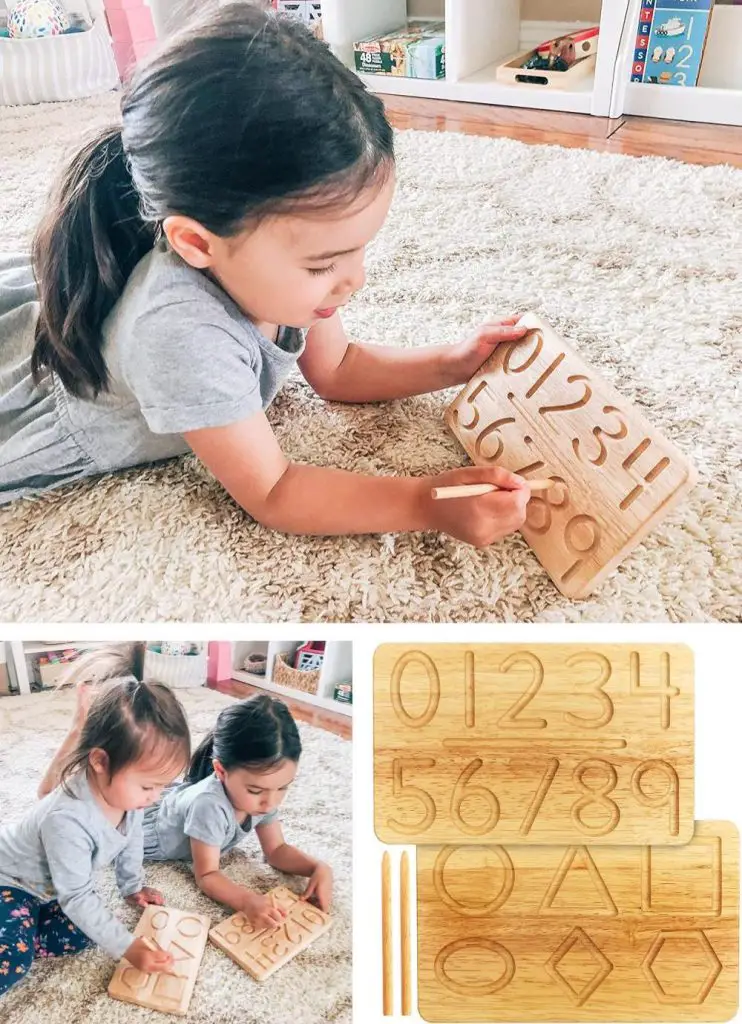
This dual Montessori tracing board allows children to follow with their fingers or with a wooden pencil the shape of the numbers from 0 to 9 and on the other side, they can follow 6 types of geometric figures, to give them some knowledge about geometry.
Practicing tracing with the fingers is a sensory way of recognizing shapes and elements, besides preparing the hand to have the posture and muscle memory at the time of writing.
In addition, this type of resource allows to teach the chronology of the first numbers, and to name the shapes that are often present in their toys.
The board is made of natural ecological wood, and has a length of 8 x 5 x 0.6 inches.
This resource is suitable for children from 3 years old.
(13) Melissa & Doug Preschool Pattern Blocks with Wooden Trays / Boards (120 Piece Set)

The set to assemble figures with patterns of geometric shapes greatly encourage concentration and problem solving in children from 4 years old.
This set is presented in wooden boards with different colorful mozaics (patterns) for children to copy the figure, with the different pieces included. You can replicate the figure on the image by placing the pieces on the original pattern or you can make the drawing separately having the image as a base.
The whole game is made of wood, includes 10 patterns and 120 elements to form the figures (includes a wooden box for storage).
It allows many activities, such as figure recognition, color grouping, counting figures, creating free-form drawings, among others.
(14) Deco Play Baby Felt Geometric Shapes for Early Years Tactile-Visual Learning

Felt shapes never go out of style, especially if they encourage sensory and tangible aspects in children.
This set includes 8 shapes for children to learn the colors and shape recognition of:
- Circle
- Triangle
- Oval
- Square
- Rombus
- Heart
- Star
- Rectangle
Each one measures approximately 2.5 inches and are 100% handmade.
They are made with polyester fibers from recycled plastic bottles. The filling is completely hypoallergenic.
Can be introduced to babies from 12 months for sensory work, and later with numbers and shapes.
(15) Wanderwood Co. Essential Shapes Wood Lacing Toy with Toddler-Safe Thread

This wooden string toy is perfect for studying geometric shapes and practicing sewing skills in young children.
It consists of 8 different shaped beads and a wooden pencil with a string attached.
Each geometric figure has rounded edges to avoid injury to children, and they are the perfect size to hold with one hand and try to insert the pencil and thread with the other hand.
The game is complete when the child is able to thread all the figures.
Includes 8 figures made of solid natural wood and completely ecological, ultra soft touch.
The game is stored in a cotton bag, and is light to carry.


