

Baby Walkers Offer Safety, Stability & Fun!
Watching your baby take their first independent steps is a monumental milestone, filled with excitement and a touch of nervousness. As parents, we want to provide the safest, most supportive tools to aid their journey from crawling to walking. While plastic walkers flood the market, a timeless, sturdy, and often more developmentally beneficial option stands out: the wooden baby walker.
At Oddblocks, we understand the importance of quality, safety, and engagement. That’s why we’ve meticulously researched and hand-picked the best wooden baby walkers, focusing on stability, non-toxic materials, engaging features, and long-lasting durability. This guide isn’t just about finding a walker; it’s about choosing a trusted companion for your little one’s big adventure into mobility.
Affiliate Link Disclosure – If you see a product you like and click through to buy it, I would genuinely appreciate it. I may earn a small commission — at no extra cost to you. It would mean a lot, thanks!
Why Choose a Wooden Baby Walker Over Plastic? The Oddblocks Advantage
Before diving into our top recommendations, let’s explore why discerning parents often gravitate towards wooden baby walkers:
- 1. Superior Stability & Durability: Wood offers a substantial weight and robust construction that inherently provides greater stability, reducing the risk of tipping. Unlike flimsy plastic, wooden walkers are built to withstand years of enthusiastic play.
- 2. Eco-Friendly & Non-Toxic: Crafted from natural materials, wooden walkers often feature non-toxic paints and finishes, making them a safer choice for babies who love to explore with their mouths. They’re also a more sustainable option.
- 3. Enhanced Developmental Benefits: Many wooden walkers double as activity centers, promoting fine motor skills, cognitive development, and problem-solving through integrated puzzles, beads, and sorting games. The resistance from wooden wheels also encourages proper muscle development for walking.
- 4. Aesthetic Appeal: With their classic charm and natural finishes, wooden walkers blend beautifully into any home decor, offering a timeless toy that parents often appreciate as much as their children.
- 5. Longevity & Heirloom Quality: A well-made wooden walker can be passed down through generations, becoming a cherished family item rather than a disposable plastic toy.
Understanding Baby Walkers: Push vs. Sit-in (and Why Push Walkers Reign Supreme)
It’s crucial to distinguish between the two main types of baby walkers, as their developmental impact and safety profiles differ significantly:
Sit-in Walkers (Traditional Walkers): These are the wheeled frames where a baby sits with their legs dangling through holes, allowing them to propel themselves. While popular in the past, medical and safety experts (including the American Academy of Pediatrics) strongly advise against them.
Why they’re discouraged: Sit-in walkers can delay independent walking, encourage an unnatural toe-walking gait, and are a major safety hazard due to increased speed and accessibility to dangers (stairs, hot objects). They do not teach balance or coordination.
Push Walkers (Activity Walkers/Wagon Walkers): These are the type we focus on at Oddblocks. Babies stand behind them, grasping a handle, and push the walker forward as they take steps.
Why they’re recommended: Push walkers encourage babies to develop balance, coordination, and leg strength naturally, much like pushing a stroller. They support a proper heel-to-toe gait and provide a sense of security without hindering developmental milestones.
Our Focus: All the wooden baby walkers reviewed in this guide are push walkers, designed to support your baby’s natural progression to walking in a safe and developmentally appropriate manner.
Our Top Picks: The Best Wooden Push Baby Walkers for Safe & Fun Mobility
Here are our expert-curated selections for the best wooden baby walkers, chosen for their quality, safety features, engaging designs, and overall value.
1. Hape Wonder Walker
Why We Love It: The Hape Wonder Walker truly lives up to its name, offering a fantastic blend of stability and engaging activity. Its design incorporates four distinct activity areas on the front panel—a shape sorter, spinning gears, a bead maze, and a small xylophone—making it a full sensory experience. We particularly appreciate the adjustable resistance on the wheels, which allows you to slow it down for beginners and loosen it as your baby gains confidence. The wide base and sturdy wooden construction provide excellent tip-over resistance, giving parents peace of mind. It’s a walker that grows with your child’s skill level and keeps them entertained long after they’ve mastered walking.
Pros: Highly stable, adjustable wheel resistance, multiple built-in activities, durable Hape quality, non-toxic finishes.
Cons: Activities are only on one side, can be bulky for smaller spaces.
Key Features: Adjustable speed control, four integrated activity zones, sturdy plywood and rubberwood construction, safe water-based paint.
2. PlanToys Baby Walker
Why We Love It: PlanToys is renowned for its sustainable practices and heirloom-quality toys, and their Baby Walker is no exception. Crafted from reclaimed rubberwood, it features a unique adjustable handle that can be positioned at two different heights, accommodating various stages of growth and ensuring comfortable posture. The spacious storage basket at the front is a brilliant addition, allowing little ones to transport their favorite toys or books, turning walking practice into a purposeful play activity. Its simple, elegant design and smooth, silent wheels make it a joy to push, while the inherent weight of the wood provides solid stability for new walkers.
Pros: Eco-friendly materials, adjustable handle height, large toy storage, excellent stability, minimalist design.
Cons: Fewer integrated activities compared to some others, higher price point.
Key Features: Sustainably sourced rubberwood, non-toxic water-based dyes, two-position adjustable handle, large storage compartment, silent rubber-rimmed wheels.
3. Radio Flyer Classic Push & Play Walker
Why We Love It: For a touch of nostalgia and reliable functionality, the Radio Flyer Classic Push & Play Walker is a timeless choice. Known for their iconic wagons, Radio Flyer delivers on durability and a classic aesthetic. This walker features a sturdy wooden body with four sturdy wheels, including non-scuffing rubber tires that protect your floors. The front panel includes a fun activity center with clicking gears, spinning panels, and bead mazes, providing ample entertainment. What stands out is its balanced weight distribution, offering consistent support without feeling overly cumbersome for a developing walker. It’s a robust option that feels classic yet modern in its design.
Pros: Iconic brand reliability, integrated activity panel, durable wood construction, non-scuffing wheels, good value.
Cons: May feel a bit heavier for very young or smaller babies initially.
Key Features: Durable wooden body, non-scuffing rubber tires, clicking gears, spinning panels, and bead maze, classic red finish.
4. Melissa & Doug Chomp & Clack Alligator Push Toy
Why We Love It: Melissa & Doug are masters of creating engaging, high-quality wooden toys, and their Chomp & Clack Alligator Push Toy is a delightful twist on the traditional walker. While not a full activity center, its unique charm lies in the three wooden alligators whose mouths “chomp” and “clack” as the walker moves forward, providing auditory and visual stimulation that encourages babies to keep pushing. This playful interaction is a huge motivator for little ones who are just finding their feet. It’s lightweight enough for easy maneuverability but still provides ample stability, making it ideal for babies who are nearly walking independently and need that final push of confidence and fun.
Pros: Highly engaging “chomping” action, lightweight yet stable, durable Melissa & Doug construction, simple assembly.
Cons: Limited additional activity features, less substantial for very early walkers needing maximum support.
Key Features: Three wooden alligators that “chomp” and “clack,” smooth-rolling wheels, bright, child-safe paint, easy-to-grasp handle.
5. BRIO Toddler Wobbler
Why We Love It: The BRIO Toddler Wobbler is a beautifully engineered piece, renowned for its exceptional quality and smart design. What truly sets it apart is its unique braking system. You can easily adjust the friction on the wheels, transforming it from a slow, stable support for early walkers into a faster, more challenging push toy as your child gains proficiency. This adaptability ensures a perfect level of support at every stage. Its clean, Scandinavian design is both elegant and highly functional, focusing purely on assisting mobility without overwhelming distractions. The solid wooden construction and high-quality paint are built to last, making it a true investment in your child’s development.
Pros: Advanced adjustable braking system, superior stability, heirloom quality, sleek Scandinavian design, very durable.
Cons: Higher price point, no integrated activity features.
Key Features: Adjustable friction brake, sturdy wooden construction, high-quality non-toxic finishes, simple and functional design.
6. Childcraft Wooden Push-Along Walker Wagon
Why We Love It: This walker wagon from Childcraft offers robust construction and incredible versatility. Its primary benefit is the generous wagon space, which encourages imaginative play as children can load it up with their favorite blocks, dolls, or other treasures. This functionality not only adds fun but also provides extra weight, contributing to its superb stability – a key factor for less confident walkers. The wide, low design makes it very difficult to tip over, and its smooth-rolling wheels handle various floor surfaces with ease. It’s an excellent choice for parents looking for a simple, highly durable, and multi-purpose push walker that doubles as a toy storage solution.
Pros: Very stable due to wagon design, large storage capacity, simple and classic aesthetic, extremely durable build.
Cons: No integrated activity panel, less compact than some other models.
Key Features: Large wooden wagon compartment, wide and stable base, robust handle, smooth-rolling wheels, natural wood finish.
7. I’M TOY Walker with Activities
Why We Love It: The I’M TOY Walker is a true multi-tasker, packed with an impressive array of activities that make it an exceptional value. It boasts a bead maze, an abacus, spinning blocks, and a shape sorter, transforming the walker into a comprehensive sensory play station. Beyond the activities, it also includes a small storage space in the back, perfect for stashing tiny treasures. The walker itself is well-balanced, with a sturdy handle and wide wheel base providing reliable support. We particularly appreciate how it encourages both gross motor skills (walking) and fine motor skills (manipulating the activities), making it a holistic developmental toy for toddlers.
Pros: Abundance of integrated activities, additional storage, solid wood construction, promotes both gross and fine motor skills.
Cons: Can be overwhelming for some babies due to many activities, heavier build.
Key Features: Multiple front-facing activities (bead maze, abacus, spinning blocks, shape sorter), rear storage compartment, sturdy wood construction, non-toxic paints.
The Ultimate Buying Guide: What to Look For in a Wooden Baby Walker
Choosing the perfect wooden baby walker involves more than just aesthetics. Here’s a comprehensive checklist of features and considerations to ensure you pick the best one for your little one:
1. Materials & Durability
Solid Wood Construction: Look for walkers made from solid, high-quality woods like rubberwood, birch, or maple. These are naturally strong and less prone to splintering or breaking than composite materials.
Non-Toxic Finishes: Ensure all paints, stains, and lacquers are non-toxic, lead-free, and ideally water-based, meeting strict safety standards (e.g., ASTM F963 in the US, EN71 in Europe). Babies will inevitably mouth their toys.
Smooth Edges: Check for finely sanded, rounded edges and corners to prevent scrapes and bumps.
2. Stability & Wheels
Wide Base: A broad base provides a larger footprint, making the walker much harder to tip over. Look for designs that are wider at the base than at the handle.
Weight Distribution: A heavier walker (especially at the bottom) or one with a toy-carrying capacity (like a wagon) offers more resistance and stability for early walkers.
Rubberized or Non-Skid Wheels: Crucial for safety! Rubber-rimmed wheels provide better grip on various surfaces (hardwood, tile) to prevent slipping and excessive speed. They also protect your floors from scratches and reduce noise.
Adjustable Wheel Resistance (Speed Control): Some premium walkers allow you to tighten or loosen the wheels. This is a fantastic feature, enabling you to slow down the walker for beginners and increase the speed as your baby gains confidence and strength.
3. Activity Centers & Engagement
Integrated Play: Many wooden walkers feature built-in puzzles, bead mazes, shape sorters, spinning blocks, or musical elements. These not only entertain but also promote fine motor skills, hand-eye coordination, and cognitive development.
Variety of Activities: Look for a good mix of activities that stimulate different senses and skill sets.
Location of Activities: Activities on the front are great for encouraging babies to stand and interact, while those on the sides or back can offer a brief break from pushing.
4. Adjustability & Growth
Handle Height: An adjustable handle allows the walker to grow with your child, ensuring comfortable posture and optimal support as they get taller.
Resistance Adjustment: As mentioned, adjustable wheel resistance extends the usability of the walker across different developmental stages.
5. Safety Considerations
No Small Parts: Ensure all attached activity components are securely fixed and too large to be choking hazards.
No Finger Traps: Check for any gaps or mechanisms where little fingers could get pinched.
Conformity to Safety Standards: Always ensure the product meets relevant safety certifications for toys and children’s products in your region.
Supervision: Remember, no walker, however safe, replaces constant adult supervision.
6. Design & Aesthetics
Style: Wooden walkers come in various styles, from minimalist Scandinavian designs to vibrant, activity-rich models. Choose one that appeals to your aesthetic and fits your home environment.
Portability/Storage: Consider the size and weight if you need to move or store the walker frequently.
When Can My Baby Use a Wooden Walker? Developmental Milestones & Safety
Timing is key when introducing a push walker to your baby to ensure it genuinely aids their development rather than hindering it.
Signs of Readiness (Typically 9-12 months):
Pulling to Stand: Your baby should be consistently pulling themselves up to a standing position.
Cruising Furniture: They should be able to “cruise” along furniture, taking several side steps while holding on.
Good Balance: They should have good head and trunk control and show signs of balancing for short periods while standing.
Motivation: They should show an interest in moving independently and exploring their surroundings.
What Not to Do: Do not introduce a push walker before your baby shows these signs of readiness. Using it too early can force them into positions their body isn’t ready for, potentially impacting gait and delaying natural walking.
Safety Tips for Using a Wooden Baby Walker:
1. Constant Supervision: Never leave your baby unsupervised with a walker, even for a moment.
2. Clear Pathways: Ensure the area where your baby uses the walker is free from obstacles, tripping hazards (rugs, wires), and anything that could fall on them.
3. No Stairs: Always ensure there are no stairs or steps in the vicinity. Walkers can gain speed quickly, making falls down stairs extremely dangerous.
4. Hazard-Free Environment: Remove any breakable items, hot liquids, open flames, or dangerous objects (e.g., cleaning supplies, medicines) from your baby’s reach. A walker increases their height and reach.
5. Appropriate Surfaces: Wooden walkers work best on flat, even surfaces. Avoid thick carpets that can snag wheels or cause tipping.
6. Proper Fit: Ensure the walker’s handle height is appropriate for your baby’s current standing height, allowing them to comfortably grasp it with a slight bend in their elbows.
How to Introduce and Maximize the Use of a Wooden Walker
Once your baby shows readiness, here’s how to make the most of their new wooden walker:
1. Start Slow: Begin with short sessions in a safe, open space.
2. Demonstrate: Show your baby how to hold the handle and gently push the walker forward.
3. Encourage: Use positive reinforcement and cheer them on! Place a favorite toy a short distance away to motivate them to take steps.
4. Make it Fun: Fill the wagon section with blocks or other toys to give them a “purpose” for pushing.
5. Vary Play: Don’t rely solely on the walker. Encourage floor play, crawling, and assisted standing/walking without the walker to develop a full range of motor skills.
Care and Maintenance Tips for Your Wooden Walker
To ensure your wooden walker lasts for years and remains safe for your child:
Regular Cleaning: Wipe down the walker regularly with a damp cloth and mild, non-toxic soap if needed. Avoid harsh chemicals.
Avoid Soaking: Do not immerse wooden parts in water, as this can cause swelling, warping, or cracking.
Inspect Periodically: Check all screws, bolts, and joints regularly to ensure they are tight and secure. Tighten as necessary.
Check for Damage: Look for any splinters, cracks, or loose parts. Repair or replace if damaged.
Storage: Store the walker in a dry environment, away from extreme temperatures or humidity, which can affect wood integrity.
Frequently Asked Questions About Wooden Baby Walkers
Q1: Are wooden baby walkers safe?
A: Yes, wooden push walkers are generally considered safe and beneficial when used appropriately and under supervision. They encourage natural development without the safety risks associated with sit-in walkers. Always ensure the product meets safety standards and is free of small parts or toxic finishes.
Q2: What’s the ideal age for a wooden push walker?
A: Most babies are ready for a push walker between 9 and 12 months, once they can pull themselves to a standing position and are cruising along furniture. Introducing it too early can hinder natural development.
Q3: Can a wooden walker really help my baby walk faster?
A: A push walker doesn’t necessarily make a baby walk “faster,” but it provides excellent support and builds confidence and strength, encouraging the natural progression of walking. It supports the development of balance and coordination.
Q4: Do wooden walkers work on carpet?
A: It depends on the carpet thickness and the walker’s wheels. Most wooden walkers with rubberized wheels will work on low-pile carpet, but thick, plush carpets can create resistance, making it harder to push and potentially causing tipping. Hard, flat surfaces are ideal.
Q5: Are the activities on wooden walkers truly beneficial?
A: Absolutely! Integrated activities like bead mazes, shape sorters, and gears promote fine motor skills, hand-eye coordination, problem-solving, and sensory exploration, adding another layer of developmental value to the walker.
Q6: How do I choose between a simple wooden walker and one with many activities?
A: Consider your child’s personality and developmental stage. A simple walker is great if your child is easily overstimulated or you prefer them to focus solely on walking. An activity-rich walker offers more sustained engagement and additional skill development, making it a longer-term toy.
The Final Step: Empowering Your Little Walker
Choosing a wooden baby walker is an investment in your child’s developmental journey. By opting for a sturdy, safe, and engaging wooden push walker, you’re offering a tool that builds confidence, strengthens muscles, and encourages independent exploration.
We hope this comprehensive guide empowers you to select the perfect wooden companion for your baby’s exciting first steps and many adventures to come! Happy walking!
***
For parents looking forward to your baby’s first steps, here are the best wooden baby walkers and why they’re great.
Today we’ll compare by age — and find the best walker for your baby’s age and developmental stage.
Most baby walkers are labeled for 12 months and up — but with proper safety precautions, certain baby walkers are suitable for babies as young as 6 months.
As soon as your little one starts scooting around, they’re ready to play with certain types of baby-safe walker toys. (Not a bouncy seat, those are bad.)
Modern baby walkers offer activities that your baby can enjoy even before they can walk — like open-ended blocks, games, and puzzles.
Let’s walk you through what you need to know.
Affiliate Link Disclosure – If you see a product you like and click through to buy it, I would genuinely appreciate it. I may earn a small commission — at no extra cost to you. It would mean a lot, thanks!
In a hurry?
You’ll miss out on all sorts of helpful tips I wrote about later in this baby walker shopping guide…
But if you’re short on time — here’s the fast way to find one right for you:
- Lababe 3-in-1 wooden activity center is best for 9 Months
- Cossy wooden baby learning walker perfect for 12 Months
- Cossy Wooden baby walker is ideal for 18 Months
- Radio Flyer classic walker wagon is big enough for 24 Months and up
- Luma Goods Co. offers the most stylish walking wagon of the bunch
- Le Toy Van includes a top-of-the-line wooden block set
5 Reasons To Love Baby Walkers (Plus A Word Of Caution)
(A) Push toys are fun and full of excitement for babies. What better way to encourage taking baby steps toward walking!?
(B) Babies need exercise! Set up a safe environment for your baby to move around in — you’ll thank yourself later while they’re sound asleep. Here’s to active healthy babies!
(C) Babies need a little support sometimes. A tiny bump or scrape — and a parents’ embrace is like a million warm blankets. While your baby’s trying to pull themselves up and stay standing up — a baby walker is the ideal support.
(D) The wooden baby walkers we recommend are stable, sturdy, and baby-safe. That’s to help your baby achieve stability and balance as they learn to walk.
(E) Not to mention — for hardwood floors, you need wooden walkers with protective rubber wheels that won’t cause any wear and tear. Plus they grip the floor better for added stability. You can thank me for that tip later!
Friendly Word Of Warning
Harvard pediatricians say “bouncy seat” baby walkers are unsafe, and are known to lead to serious accidents.
Don’t buy a baby walker with a bouncy seat and wheels.
Instead, shop for baby-safe wooden walkers.
The two are very different.
Best Wooden Baby Walkers For 9-24 Months
Best For 9 Months: Labebe Activity Push Toy
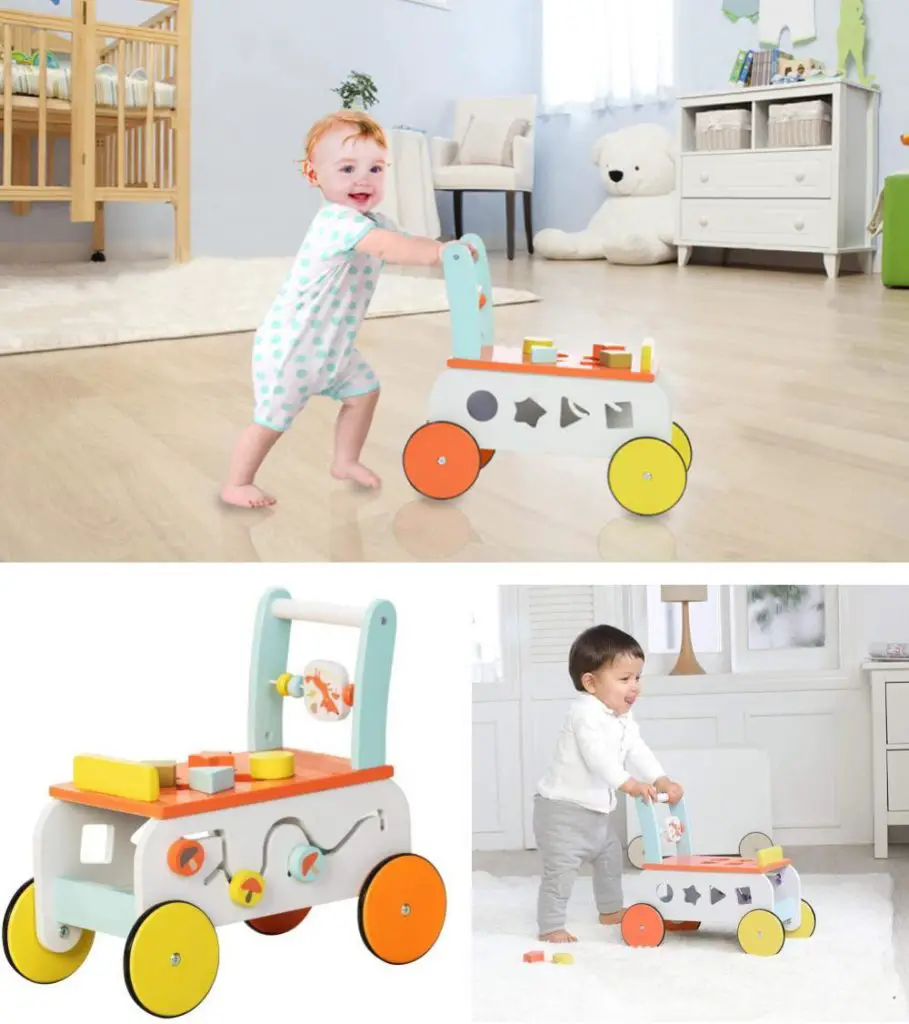
Labebe brand’s baby learning walker is a 3-in-1 wooden activity push toy.
While it’s recommended for ages 12 months to 3 years on the label — every detail of this toy is thoughtfully designed best suited for the younger months.
Can a 6-month-old baby use a walker? With proper supervision, babies can start playing with their walker as early as 6 or 9 months.
Part push cart, part walker wagon, part toy chest — as your developing baby learns the ropes walking around, they’ll discover a versatile range of educational activities to try.
Babies can sit on the floor playing independently. Or stand up, push the cart, and get walking.
Plus, it’s got quality rubber ring wheels to protect your hard floors.
Labebe brand also offers ab adorable animal-shaped baby walker and a stimulating animated musical baby walker.
Best For 12 Months: Cossy Wagon Walker With Blocks
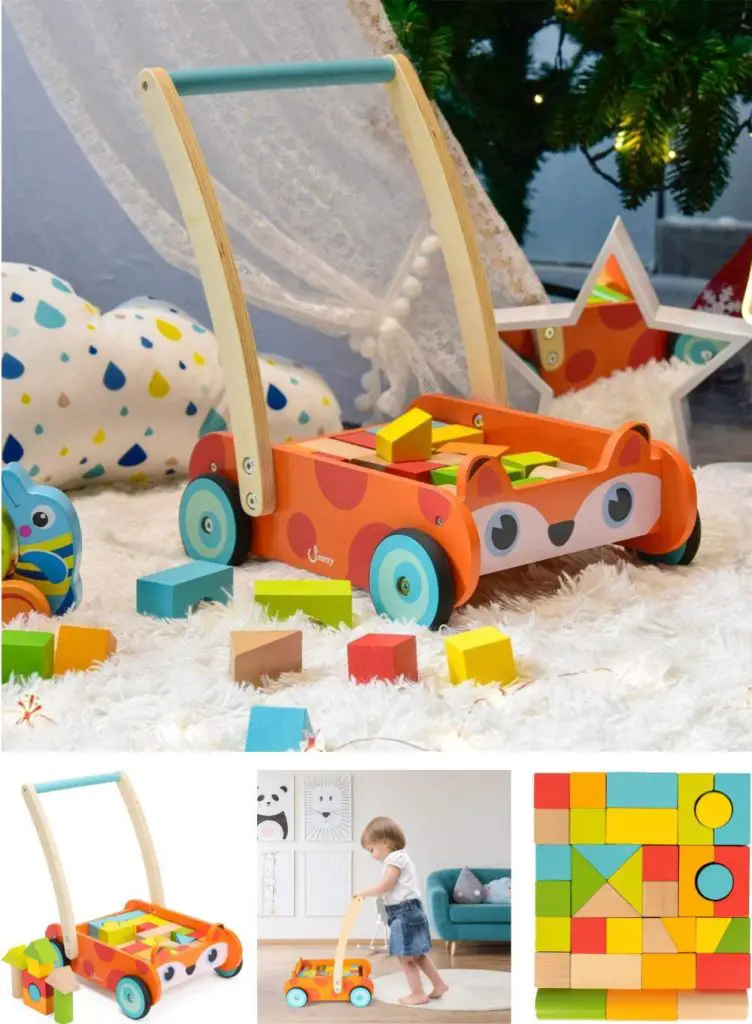
Cossy brand’s wooden baby walker with bright and smiley blocks is absolute eye candy!
With tropical colored blocks in lime and mango and an adorable animal-shaped wagon — this baby walker with blocks is best suited for one-year-olds to explore the world around them.
12 months old is the perfect age to boost your child’s fine motor skills with activities like block play.
Cossy’s baby blocks walker comes with 34 blocks in all shapes and sizes — cubes, rectangles, triangles, arches, and columns.
Best For 18 Months: Cossy Baby Activity Walker
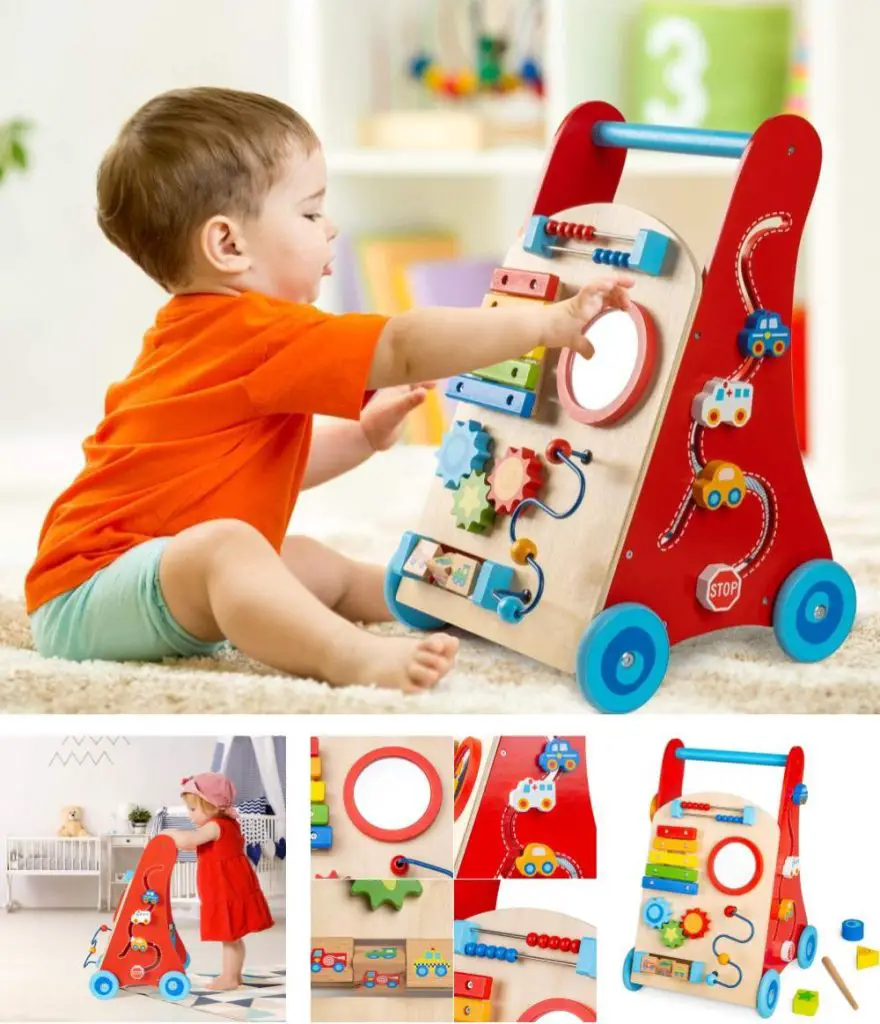
Recommended for babies 18 months and up, cossy brand’s baby activity walker is a first birthday gift your little one will be glad to receive.
Unlike other baby walkers we’ve looked at so far — this toy is part baby walker, part activity cube.
Get ready for all sorts of fun baby games, a baby counting abacus, a working xylophone, and rubber-trimmed setback wheels!
Made baby-safe and learning-friendly with all-natural wood, count on an exciting activity center to keep your baby busy!
Best For 24 Months: Radio Flyer Baby & Toddler Push Wagon
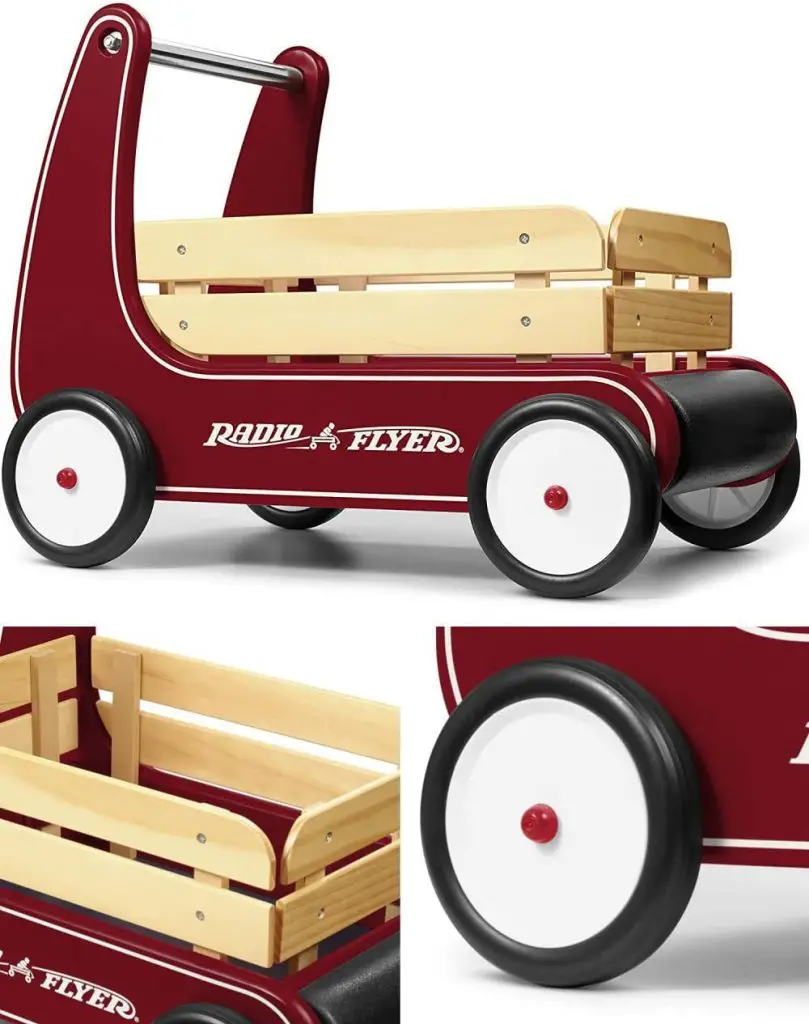
Into Americana? Try Radio Flyer’s traditional wooden walker for babies.
Radio Flyer brand has been serving America for decades. A fusion of the alluring traditional look and modern walker technology.
Believe me, baby walkers’ safety and walkability have come a long way since I was a kid.
Radio Flyer is a classic American brand that’s been around since WWII. They’re a modern classic toddler walker wagon — like a piece of Americana for your little one’s first steps.
Suitable for ages from 1 to 4 years. Even after your little one turns two, they’ll still get years of playtime out of this timeless wooden wagon.
Best Wooden Baby Walker Wagons: Lifestyle Picks
Most Stylish: Luma Goods Co. Wooden Walker Wagon
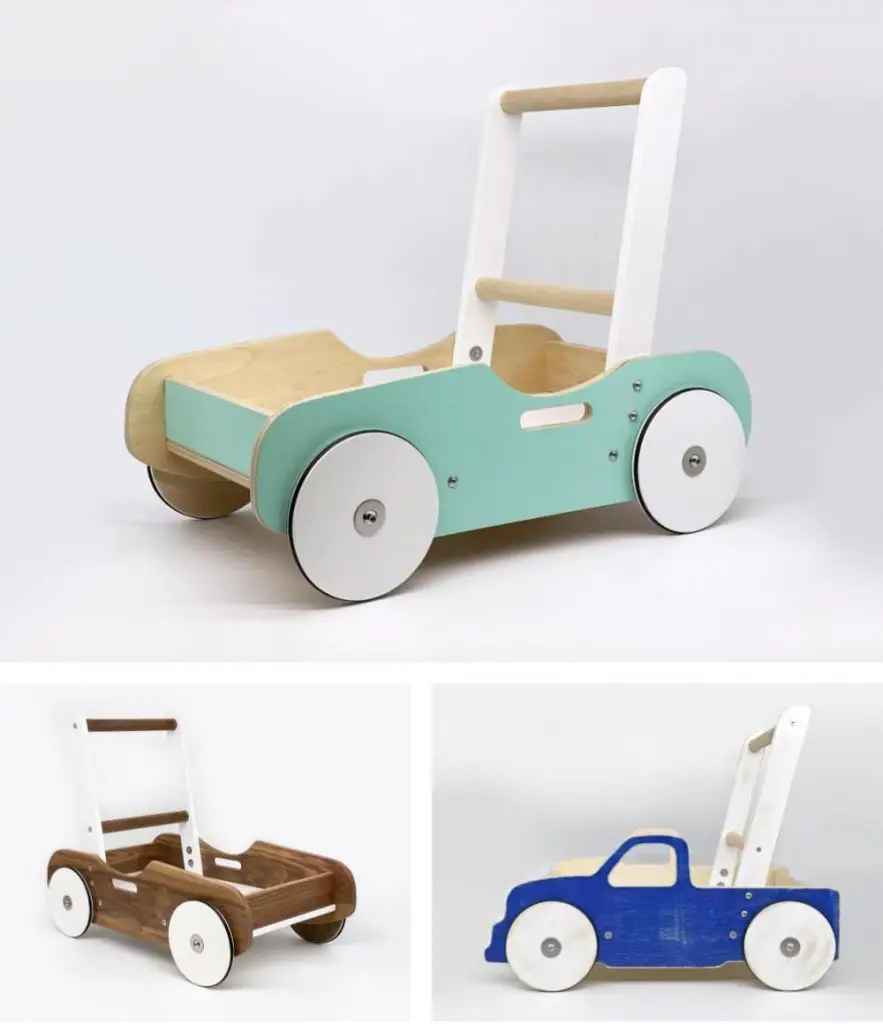
With a cool retro feel in a modern color palette, the Luma Walker’s elegant Nordic design truly sets it apart from the rest.
For parents who love toys with fresh aesthetics, this one’s the most fashion-forward baby walker available.
It’s a 2-in-1 toddler walker and wagon, with open storage for toys, blocks, clothes, and more!
Best Block Set: Le Toy Van Rainbow Blocks Baby Walker
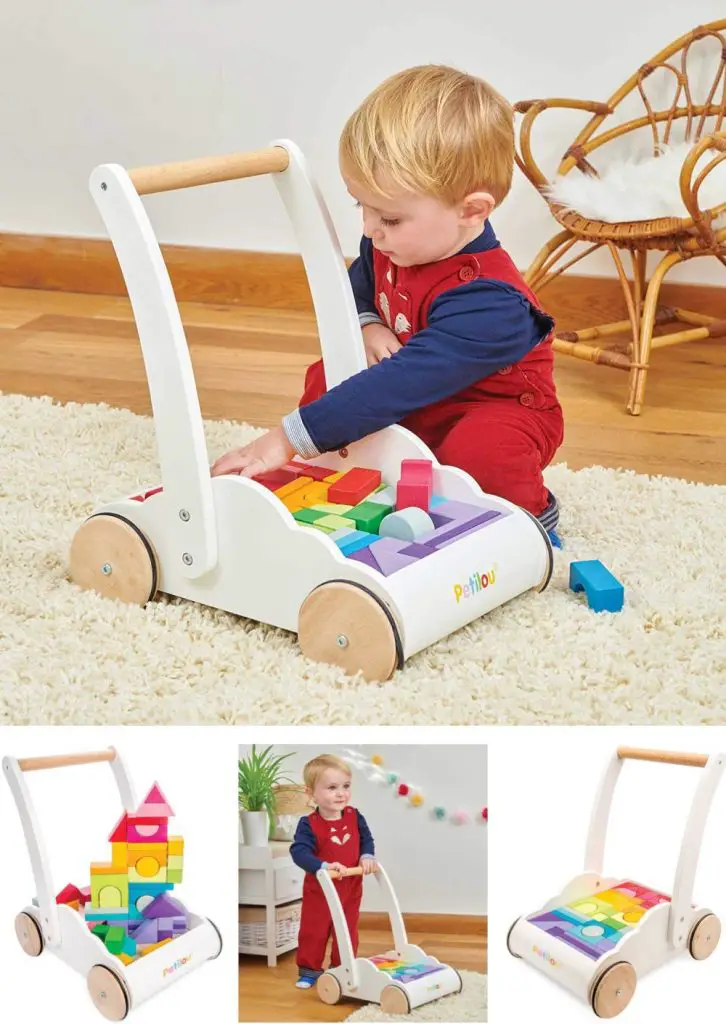
For babies who love blocks, here’s your best bet!
Le Toy Van’s Petilou rainbow cloud walker toy comes in a delightful soft cloud shape for a whimsical babyhood!
But the real attraction here is the blocks!
The wagon comes equipped with 45 premium rubber wood blocks painted in baby-safe non-toxic rainbow colors.
It’s an ultra-creative open-ended block set — including rainbow-colored wooden unit blocks in an educational variety of sizes, shapes, and colors. Beautiful color.
The blocks are specially designed for small hands — so this is a baby walker block set perfect for your little one’s early years.
Baby Walkers 101: FAQ & Parent’s Guide
Activity Center vs. Wagon With Blocks – Which Is Better?
The most popular baby walkers come in two distinct types.
- Baby Activity Walkers stand tall with all sorts of busy baby activities on the sides. They’re equipped with baby-friendly gizmos, puzzles, and color matching activities.
- Walker Wagons With Blocks have a low center of gravity because the heaviest part is a wide wagon with a complete set of wooden blocks that fit into the wagon perfectly.
Which type of baby walker is best? My personal preference is for the block set baby walkers. Open-ended block play lends itself to unlimited creativity — and these baby-ready unit block sets offer an amazing variety of different shaped blocks and vividly appetizing colors.
How do you teach a baby to walk in a walker? The right age to start with a baby push walker ranges from 6 months to 24 months. Young toddlers as old as 4 years may still play with their push walker.
So, it’s no wonder most of the baby walkers we looked at today are specified for 9 to 18 months. It mostly depends on your baby’s stage of motor development. Be patient, and they’ll start scooting soon!
I understand how much you look forward to your little one’s first steps. With encouragement and patience, your baby will get there!
Here are my two cents to help.
The Montessori-way would be to leave the brand new walker accessible in your baby’s playroom. The idea is to let your child explore at their own pace.
Baby walkers are not official Montessori equipment — but their developmental principles are well aligned with an at-home Montessori environment.
Lots of parents take this back-to-basics approach, by laying their baby on the floor on their tummy and let them explore.
Your little one will eventually try out their new shiny walker. Often right away!
Be patient and present play opportunities to get them active! Your new walker will blend in perfectly.
Are Baby Walkers Banned? Are They Dangerous?
It will come as a little bit of a shock to hear that as of 2018, certain baby walkers were banned in Canada because they were deemed unsafe to use. As of 2021, the United States baby walkers are still widely available.
Why are they banned? First off, you need to know that not all baby walkers were banned. The kind with a bouncy seat installed — that’s what’s banned.
The bouncy seat hoists up children who cannot crawl or walk by themselves, leaving them unprepared they can move around before they’re ready to. And that’s what leads to accidents.
A Harvard study writes about bouncy seat walkers:
Learning to walk isn’t so much about learning to use your legs. It’s more about learning to pull to stand and then balance and take steps without support. When babies are plopped into walkers, they don’t learn any of that. They learn it by being put on the floor with something they can pull up on, like a couch or a caregiver.
Don’t buy the baby walkers with a bouncy seat.
It’s a baby seat on wheels for babies who aren’t ready to walk.
Choose a sit-to-stand walker — one that leaves your baby’s legs free and lets your child pull themselves up on their own.
Never use any baby walker near an open staircase. Never use a baby walker near a pool. Stay away from slanted surfaces like a driveway.
Keep dangerous things out of reach, for example on surfaces your baby can now reach with the help of their walker.
Injury and accidents are much less likely for indoor use with proper safety precautions and parental supervision. That’s the right way to introduce your new baby walker.
Baby Walker Alternatives: What Else To Try
Rest assured, your baby will learn to walk one way or another.
Yes, even without buying a baby walker. The truth is babies don’t need a walker to learn to walk.
Nothing beats mommy and daddy helping them walk because no toy can compare to the power of a parent’s love, affection, attention, and encouragement.
Wooden baby walkers that check all the safety boxes are worth your serious consideration. They’re low-cost for a high-quality toy that encourages early-stage motor development.
If you’re considering a purchase different from a baby walker — there are alternatives that you can use instead of a walker.
Here are a few highlight toys that can help your baby learn to walk:
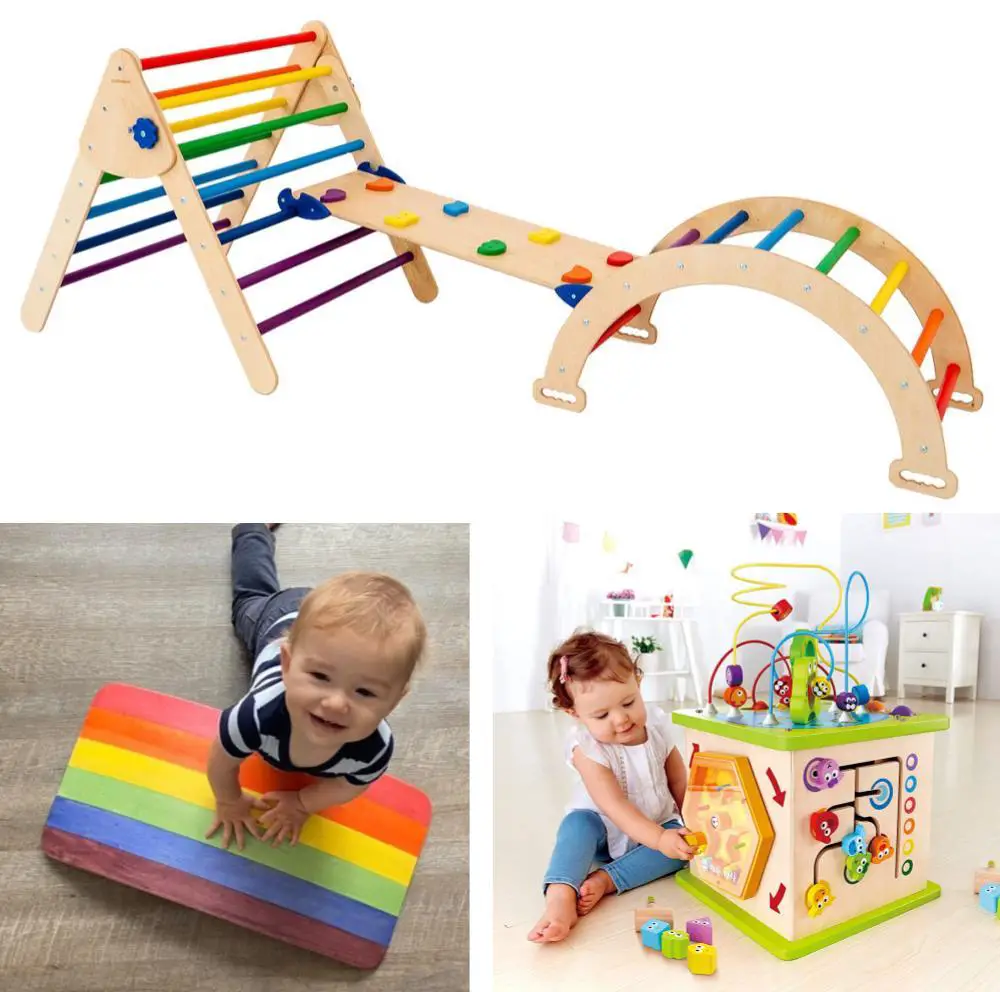
(A) Baby Activity Cube (No Wheels)
If you love the baby activity walker for its activity center — here’s a baby activity cube without wheels. Your little one will enjoy educational and entertaining baby puzzles. You’ll enjoy peace of mind knowing your baby stays put.
(B) Baby Wobble Board
Most parents hope their baby walker will help the baby learn to walk a little bit sooner. But remember, walking is not the only essential motor skill.
Balance and muscle strength can be trained before your baby takes their first steps — simply laying down or crawling. In addition to toddler and big kid sizes, you can also find baby-sized wooden wobble boards.
Bunny Hopkins brand makes the most beautiful rainbow-colored baby wobble board — available in the baby-perfect size.
We reviewed all the best wooden balance boards where you can learn more.
(C) Indoor Climbing oys
First-time parents might expect babies to walk before they can climb — but it’s quite the opposite.
When your baby’s just starting to scoot around and climb on things, maybe it’s time to consider an age-appropriate climbing toy.
Even before your baby’s ready to climb to the very top, they get lots of valuable practice with their gross motor skills (large body movements).
We reviewed all the best indoor wooden climbing toys for your further reading. You’ll discover an entirely new world with wooden climbing toys of all shapes and sizes. Eureka!
I’d recommend you take a look at the Pikler Triangle first. Wood & Hearts brand is quality, low-cost, and colorful.
Over to you!
There are lots of reasons to love wooden baby walkers. Yet some parents scare away due to what they’ve heard about bouncy seat walkers.
The two are very different types of baby toys.
Take simple safety precautions. Provide parental supervision. And watch through the smiles and giggles as your baby learns to take their first steps.


