At Oddblocks, we believe in fostering active play and developmental growth from an early age. A children’s balance beam isn’t just a fun toy; it’s a powerful tool for building essential physical and cognitive skills. But with so many options, how do you choose the right one, ensure safe play, and keep your child engaged as they grow?
Let’s Review the Best Products & Ultimate Guide to Balance Beams for Kids.
This comprehensive guide will walk you through everything you need to know, from selecting the perfect beam for your child’s age and stage, to fun activities that will keep them balancing, learning, and thriving.
Why Every Child Needs a Balance Beam: Developmental Benefits
Introducing a balance beam into your child’s play routine offers a wealth of advantages that go far beyond just fun. It’s an investment in their holistic development.
Here are the key benefits:
- Enhanced Balance & Coordination: This is the most obvious benefit! Walking on a beam helps children refine their sense of balance, improve stability, and coordinate their movements.
- Improved Gross Motor Skills: Navigating the beam strengthens core muscles, legs, and arms, contributing to overall physical agility and control.
- Boosted Confidence & Self-Esteem: Mastering a new skill, even something as simple as walking the beam, gives children a sense of accomplishment and encourages them to try new challenges.
- Spatial Awareness: Children learn about their body in space, understanding how to adjust movements to stay on the beam.
- Concentration & Focus: Staying on the beam requires sustained attention, helping to develop concentration skills crucial for learning.
- Creative Play: Beyond just walking, a balance beam can become a bridge over lava, a tightrope in a circus, or a pathway in an obstacle course, sparking imaginative play.
How to Choose the Right Kids Balance Beam: Age-Specific Guidance
Choosing the perfect balance beam means matching the beam’s features to your child’s age, skill level, and your home environment. This isn’t a one-size-fits-all purchase, especially when considering your child’s developmental stage.
Here’s a breakdown to help you decide:
1. Floor Balance Beams (Ideal for Toddlers 1-3 Years)
What they are: These beams sit directly on the floor or are very low to the ground (1-2 inches). They are often foldable or connectable.
Best for: Young toddlers just beginning to explore balance. They provide a safe, low-risk introduction, allowing children to step off and regain balance easily. Perfect for building initial confidence.
Oddblocks Recommendation: Look for soft, non-slip surfaces and sturdy foam or wood constructions that can handle wobbly steps.
2. Low Balance Beams (Perfect for Preschoolers 3-5 Years)
What they are: Slightly raised off the ground, typically 4-6 inches high. They offer a gentle progression from floor beams.
Best for: Preschoolers who have mastered walking on a floor beam and are ready for a slightly greater challenge. The minimal height adds a psychological element of “being up” without significant risk.
Oddblocks Recommendation: Prioritize stability and a solid base. Many low beams are single-piece designs for extra sturdiness.
3. Adjustable Height Balance Beams (For Early School Age & Skill Development 5-8+ Years)
What they are: These versatile beams allow you to change the height, typically ranging from a few inches off the floor to 12-18 inches.
Best for: Children ready for more advanced challenges and families looking for a beam that can adapt as their child grows and improves. It’s an excellent investment for sustained skill development.
Oddblocks Recommendation: Ensure the adjustment mechanism is secure and easy to use. Look for robust construction that maintains stability at higher settings.
Investing in Quality: A Beam That Grows with Your Child
A balance beam is an investment in your child’s physical development and play. Choosing one that can withstand active use and adapt to your child’s growth ensures long-term value.
When making your selection, consider these crucial factors for longevity and growth:
- Durable Materials: Look for high-quality wood, sturdy metal bases, and dense foam. These materials resist wear and tear, ensuring the beam remains safe and functional for years. Oddblocks products are built with longevity in mind.
- Adjustable Height Features: As your child masters lower heights, an adjustable beam allows you to increase the challenge, keeping them engaged and preventing them from outgrowing the equipment too quickly. This adaptability means one beam can serve them through multiple developmental stages.
- High Weight Limit: If you have multiple children, or anticipate your child using the beam for many years, a higher weight limit indicates a more robust construction capable of enduring more stress over time.
- Stability: A stable beam is a safe beam, but it also means it will remain effective as your child attempts more complex moves. Look for non-slip feet and wide, sturdy bases.
Safety First: Essential Tips for Home Use
Safety should always be the top priority when setting up a balance beam at home.
Follow these guidelines for worry-free play:
- Proper Placement: Place the beam on a flat, even surface, away from walls, furniture, or other obstacles. Ensure ample clear space around the beam.
- Soft Landing Area: Lay down gymnastics mats, thick rugs, or pillows around the beam, especially for higher models, to cushion any falls.
- Constant Supervision: Always supervise young children when they are using the balance beam. This allows you to intervene if needed and offers encouragement.
- Weight Limit Adherence: Always check and respect the manufacturer’s specified weight limit for the beam.
- Regular Inspection: Periodically check the beam for any signs of wear, loose parts, or damage. Address any issues immediately to maintain safety.
- Appropriate Attire: Encourage bare feet or non-slip socks for better grip. Avoid loose clothing that could get caught.
Fun Balance Beam Activities & Games for Every Age
Beyond simply walking, a balance beam can be a versatile prop for a variety of engaging activities that cater to different age groups and skill levels.
Here are some ideas to get your little one balancing and having a blast:
Toddler Treasures (Ages 1-3): Focus on Exploration & Basic Steps
- “River Crossing”: Place soft blue fabric or a blanket on either side of a low floor beam. Tell your toddler they need to cross the “river” by walking on the beam, carefully placing one foot in front of the other.
- “Step Over the Mountains”: Place a few soft toys (like beanbags or stuffed animals) on the beam. Encourage your child to carefully step over each “mountain” as they walk along.
- “Animal Walks”: Ask your toddler to walk like a bear (on all fours) or a crab (sideways) along a very low beam. This builds different muscle groups and coordination.
Preschooler Paths (Ages 3-5): Developing Coordination & Simple Sequences
- “Tightrope Walker”: Encourage them to walk heel-to-toe, just like a real tightrope walker! You can add a scarf to wave or a pretend parasol for extra fun.
- “Follow the Leader”: You go first, performing a simple sequence (e.g., walk three steps, turn around, walk back). Then, have your child try to imitate your movements.
- “Obstacle Course Creator”: Integrate the balance beam into a larger obstacle course. They might crawl under a chair, walk the beam, and then jump over a pillow. This sparks imagination and integrates multiple skills.
- “Backward Steps Challenge”: Once they’re confident walking forward, gently encourage them to try taking a few steps backward on a low beam, with close supervision.
School-Age Skills (Ages 5-8+): Building Advanced Control & Agility
- “Turns & Poses”: Challenge them to walk to the middle, perform a full turn, and walk back. Or, walk to the end, strike a “superhero” pose, and then walk off.
- “Beanbag Balance”: Have them walk the beam while balancing a small beanbag or soft toy on their head. This adds an extra layer of challenge and focus.
- “Jump On/Jump Off”: From the side of a low-to-medium height beam, have them practice carefully jumping onto the beam with both feet, holding their balance, and then jumping off. Ensure a soft landing mat is in place.
- “Creative Sequences”: Encourage them to create their own “routine” – perhaps a walk, a small jump, a turn, and a pose. They can even perform it to music!
Start Balancing with Oddblocks!
At Oddblocks, we’re dedicated to providing high-quality, safe, and engaging balance beams that support your child’s growth every step of the way. From their first wobbly steps on a floor beam to mastering impressive routines on an adjustable model, we have the perfect solution for your family.
Explore our collection today and give your child the gift of balance, confidence, and endless active play!
***
Wooden balance beams improve balance, boost body awareness, and provide a healthy outlet for exercise.
We’ve completed a well-balanced comparison and review of the best wooden balance beams for toddlers and kids.
You’ll learn the difference between two-way balance beams and modular balance beams — and which is better.
No, we’re not talking about balance boards. A balance beam is a long plank along the floor. Children walk across the balance beam keeping balance.
Today we’re all about the straight and narrow — top-quality kids balance beams.
Affiliate Link Disclosure – If you see a product you like and click through to buy it, I would genuinely appreciate it. I may earn a small commission — at no extra cost to you. It would mean a lot, thanks!
In a hurry?
How to choose the best balance beam for your child? Here’s a fast-track summary of what to look for.
For toddlers ages 2 to 3 who are new to walking, look for a modular wooden balance beam with segments that can be set up into different patterns each time. Pick one that’s low to the ground for added safety.
For kids ages 4 to 6 with more advanced motor skills, I recommend a balance beam that is larger and higher up. Especially if your child is training for gymnastics or dance, think about skipping the Montessori-style play beams and go straight for children’s sized professional gymnastics beams.
Here are 2025’s best balance beams in Oddblocks Opinion:
- (01) Constructive Playthings Two-Way Wooden Balance Beam (Best For Outside Use)
- (02) Wooden Balance Rainbow Balance Beam (Most Beautiful Colors)
- (03) Wiwiurka Montessori Balance Beam (Most Eco-Friendly)
Top 3 Balance Beam Benefits
(A) Balance
Your child will build core strength and improve their ability to balance their bodies. Balance is an essential skill for nearly all athletics. It’s a very important aspect of your toddler’s overall gross motor skills. Not to mention the boost in self-confidence that comes from learning to move your body.
(B) Body Awareness
Beyond balance and gross motor — Practice makes perfect. The more your child plays walks on their balance beam, the more your child gets acquainted with their bodies. Balance beams encourage flexibility and coordination — so your child will explore their body’s capabilities and limits.
(C) Active Play
Kids need exercise! With flashy smartphone screens to play with, children are as sedentary as ever. Routine exercise is a healthy habit that’s worth learning early in life. Balance beams can be used both indoors and outdoors to keep your kid moving in the daytime and have a peaceful sleep at night.
(01) Constructive Playthings
Visit the Constructive Playthings official website.
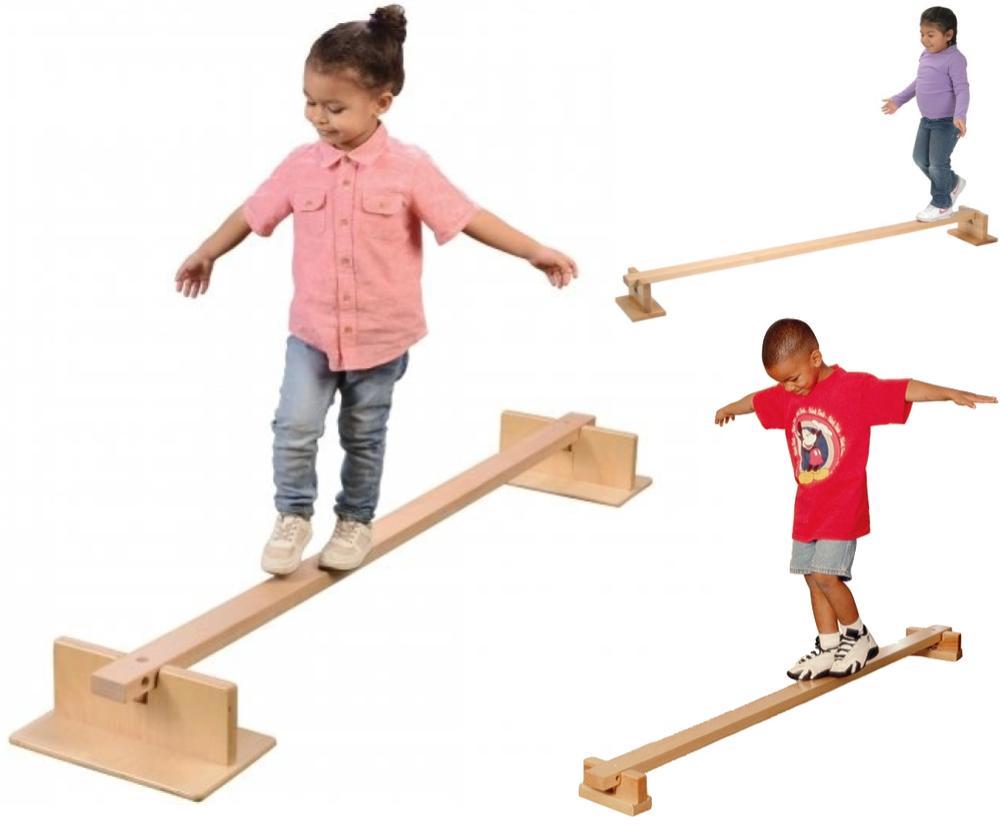
Sturdy Base Indoor/Outdoor Balance Beam. All balance beams can be used outside, but most are intended for indoor use. It’s best to use it on the lawn (not a hard surface) and store it in a dry place indoors when not in use.
For a backyard-ready balance beam, look for one raised off the ground with just two ends.
This way, if your lawn isn’t exactly level, the two-way balance beam will stand sturdy raised above the grass.
Constructive Playthings‘ two-way children’s balance beam is perfect for outside play. It’s raised 6 inches off the ground, made of solid hard maple wood, and has rounded edges to prevent injury.
Best for ages 3 years and up, it’s an excellent choice for summertime outdoor gymnastics and fun.
Of course, it can be played indoors too.
For toddlers on the gymnastics track, Constructive Plaything’s off-ground balance beam is a good first step practice pad before they’re ready for a full-sized kids gymnastics balance beam, like Tumbl Trak brand’s Addie Beam (8 feet).
(02) Wooden Balance
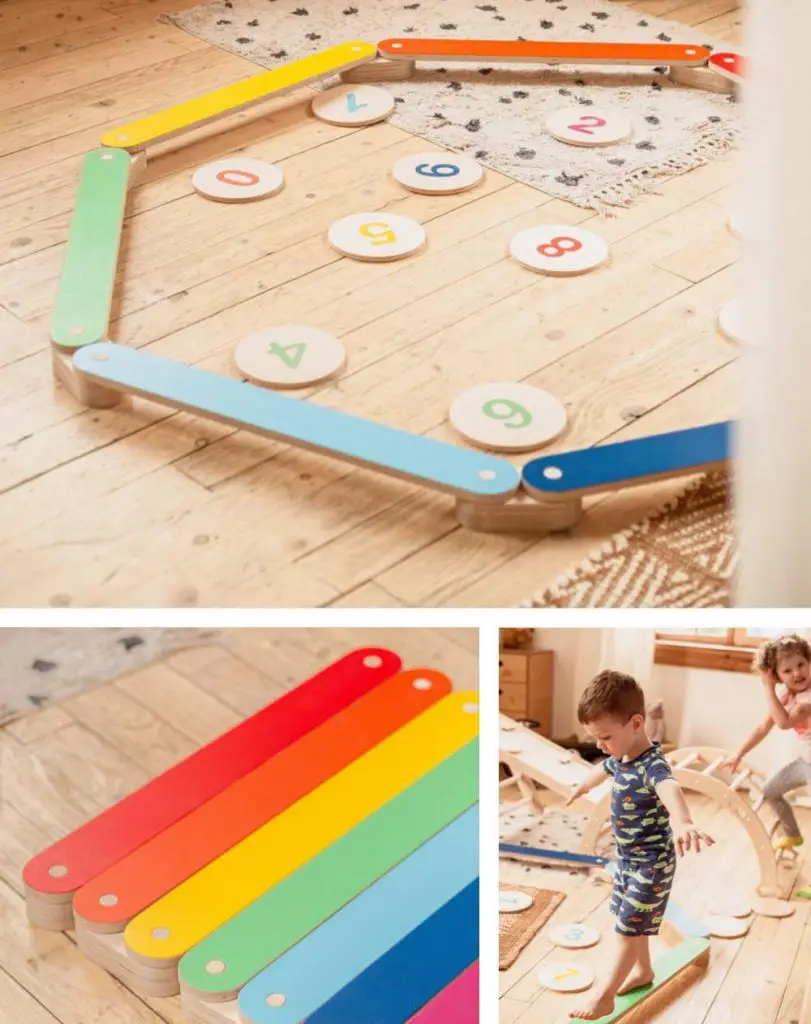
Rainbow Balance Beam. Love the versatile modular style, but craving some color in your playroom?
Here’s a wooden rainbow balance beam that lets your child set out different patterns every time!
Wooden Balance brand’s wooden rainbow balance beam is available in both primary and pastel color palettes — adding a splash of color into the room.
Modular like other children’s beams we’ve looked at — you can order as few or as many segments as you like, and even pick the height you want. Lower for beginner walkers and higher for more advanced kids.
Brightly colored and available for custom order — Wooden Balance brand offers a delightful shopping experience to get exactly the type of balance beam that’s right for you.
(03) Wiwiurka
Visit the Wiwurka official website.
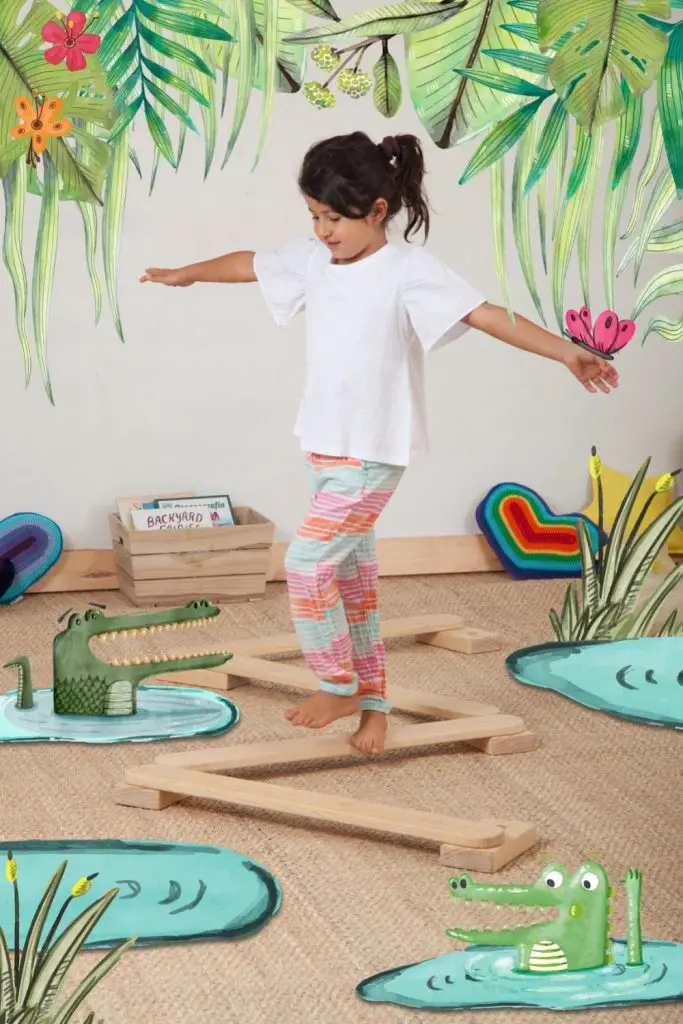
Premium Montessori Balance Beam. Here’s a top-shelf Montessori balance beam — from Wiwiurka the company that took Pikler triangle color palettes to the next level.
Wiwiurka is an eco-friendly company out of Mexico that creates Montessori solutions for your home. Their all-natural wooden play equipment is as kid-friendly as it is environmentally friendly.
The only problem might be the price. Wiwiurka chooses to hand-make all their toys using sustainable materials and manufacturing methods — a premium product with a premium price tag.
The parts are made from premium-grade pine wood — sanded smooth for safety and delivered 100% natural and unfinished. It’s designed for toddlers and kids, but sturdy enough for adults to stand on too.
Their handmade Montessori balance beam is designed modular with four 30 inch beams and 5 connector platforms. It’ll fit nicely into your Montessori home no matter the size.
Balance Beam 101: What It Is & How To Use
What Is A Kids Balance Beam?
As America gears up for Tokyo 2022, we discover young ambitious gymnasts from all over the country following their dreams towards Olympic gold.
A balance beam is a narrow horizontal bar raised off the floor used for walking across. They were invented by Friedrich Ludwig Jahn in the 1800s, and have since become widely adopted as essential gymnastics equipment.
Competition-sized gymnastics beams measure 16 feet long, so children-sized gymnastics beams usually measure 8 or 4 feet long.
For toddler’s and kid’s playtime, smaller versions devoted to play are a fun way to develop children’s balance and motor skills.
Solid wood kids balance beams typically range from 3 to 6 feet long, where modular children’s wood balance beams typically include 2 to 6 segments each 24 to 32 inches long.
These days, it’s just as important to go eco-safe as it is to go child-safe. Today I think I demonstrated that by showcasing a range of quality wooden balance beams that check all the boxes.
Balance Beam Safety Tips
To use a balance beam with your child in your home, make sure you’ve set up a safe play environment.
The balance beam should be flat on the ground — no wobbly surfaces.
Remove sharp or hard objects from the area.
Montessori and RIE education specialists believe children should be given the freedom to explore their new balance beam on their own — that parents shouldn’t assist their child.
Parents have good intentions to help their child learn faster, but in doing so you may push your child beyond their limits. It’s best to let your child lead.
Remind children to take it slow and use their arms to try to balance themselves to maintain balance. Promote body awareness by drawing attention to how they’re using their core muscles tight to keep balance on the beam.
For added safety padding in case of a trip and fall, consider laying out toddler floor tiles.
Parental supervision is always advised.
Balance Beam Alternatives
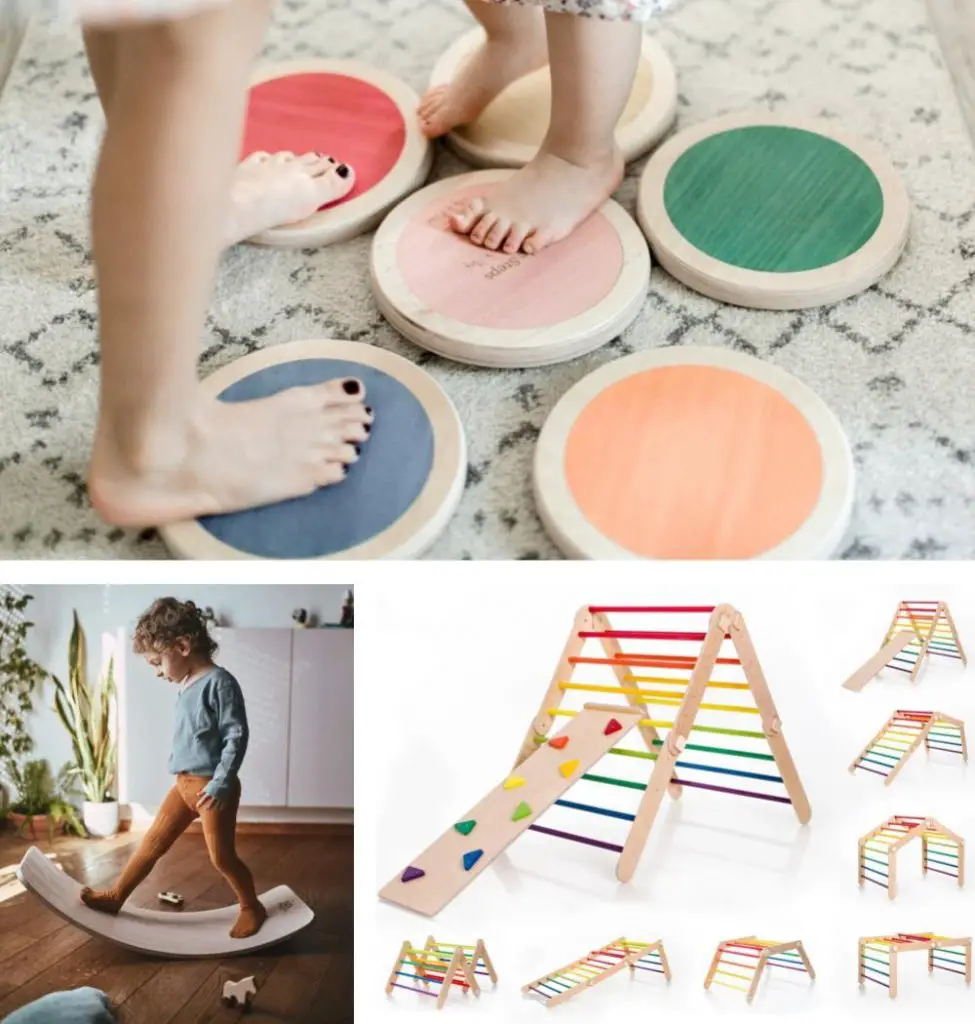
(A) Stepping Stones
Still worried you don’t have enough space for a balance beam?
Stepping stones cover nearly identical learning objectives and play activities as a balance beam.
Balance boards and balance beams work well together in a Montessori-inspired play room. Piccalio brand makes both — and they look beautiful together!
Delightful rainbow-colored wooden circles that you place on the ground — just like stepping stones to cross a whimsical stream.
Stepping stones are low to the ground, so they’re safer than raised balance beams for beginner walkers. They’re also completely versatile! Your little one can chart out infinite different paths for limitless adventures of imagination and play.
Zicoto brand makes a near-identical budget alternative for a lower price. Worth a peek before you buy!
(B) Balance Board
Balance board vs balance beam — what’s the difference?
The balance board is a U-shaped wooden board primarily used for rocking back and forth.
The balance beam is a straight beam primarily used for walking across.
Both accelerate your child’s gross motor development and foster healthy active habits!
We wrote a full roundup review of the best wooden balance boards where you can learn more about rock’n’rolling toddlers!
Kinderfeet brand’s Kinderboard is a simple Waldorf-style balance board with quality European construction at a reasonable price.
Little Dove brand’s is a little bit more whimsical! With colorful felt bottoms to protect hard floors from scratches — they look as beautiful as they play!
(C) Pikler Triangle
We love the Pikler triangle!
It’s a “fun-damental” indoor wooden climbing toy perfect for early gross motor development.
As soon as your little one starts to crawl up onto things around the house — that’s the perfect time to get one. The Pikler triangle is climb-ready for toddlers even before they can walk.
That’s one interesting contrast with the balance beam. Pikler triangles are for climbing, and balance beams are for walking. Both complement each other in a Montessori-inspired play space.
We reviewed the best Pikler triangles for you to see what’s available.
Wood Grain Lab brand is a great place to start.
Here’s to a well-balanced review!
You’re all set to decide which kind of balance is best for your family.
We looked at the best by age, and some lifestyle picks to love! Balance beams improve balance, boost body awareness, and provide a healthy outlet for exercise.
I’d love to hear where your journey ends. Let me know in the comments below!